

Responsible AI: Navigating Implications for Tech Teams
Responsible AI implementation for tech teams means embedding fairness, transparency, and accountability into every stage of AI development. It involves rigorous testing for bias, clear documentation of model decisions, and continuous monitoring to ensure systems align with ethical standards and regulatory requirements without stifling innovation.
For UK technology firms, responsible AI governance is now a procurement gatekeeper, not a philosophical choice. Early adoption of structured frameworks protects revenue pipelines and frees up marketer capacity.
- Procurement mandates: Enterprise RFPs and public-sector tenders now require documented AI risk management, even for off-the-shelf tools like Copilot and ChatGPT.
- EU AI Act duties: UK tech firms serving EU clients must classify risk and meet transparency obligations, with the prohibitions and general-purpose transparency duties already in force and the high-risk obligations following.
- Capacity reclamation: Automating governance checks and evidence capture shifts compliance effort from manual due diligence to a repeatable workflow, returning time to revenue-generating work.
- Vendor-ready frameworks: Adopting the NIST AI Risk Management Framework creates a structured evidence trail that satisfies procurement questionnaires quickly.
Introduction
For UK technology firms, the conversation around responsible AI implementation has shifted abruptly. Procurement teams, not ethics committees, are now dictating the pace. Enterprise RFPs and public-sector frameworks are silently introducing AI governance clauses, even for widely used tools like Copilot and ChatGPT. A documented AI risk management process is becoming a hard requirement, and one that mid-market businesses cannot afford to treat as optional.
The EU AI Act sets enforcement milestones that reach British companies serving European clients, with risk classification and transparency obligations already taking effect in stages. Firms without clear evidence of how they audit, document, and control AI outputs will soon be removed from tender consideration. This is not a distant regulatory horizon; it is an immediate commercial gatekeeper that can quietly lock out unprepared suppliers from their largest revenue opportunities.
Embedding governance early does more than keep doors open. The same automation dividend already visible elsewhere in the business points the way: about a third of marketers say AI saves their team 10-14 hours per week (HubSpot State of Marketing). Applied to vendor due diligence and RFP evidence packs, the same principle turns compliance work from a queue into a workflow. What follows is a practical framework for building a responsible AI position, one that satisfies procurement requirements and frees up the people who will deliver it.
Procurement Requirements: The Commercial Gatekeeper
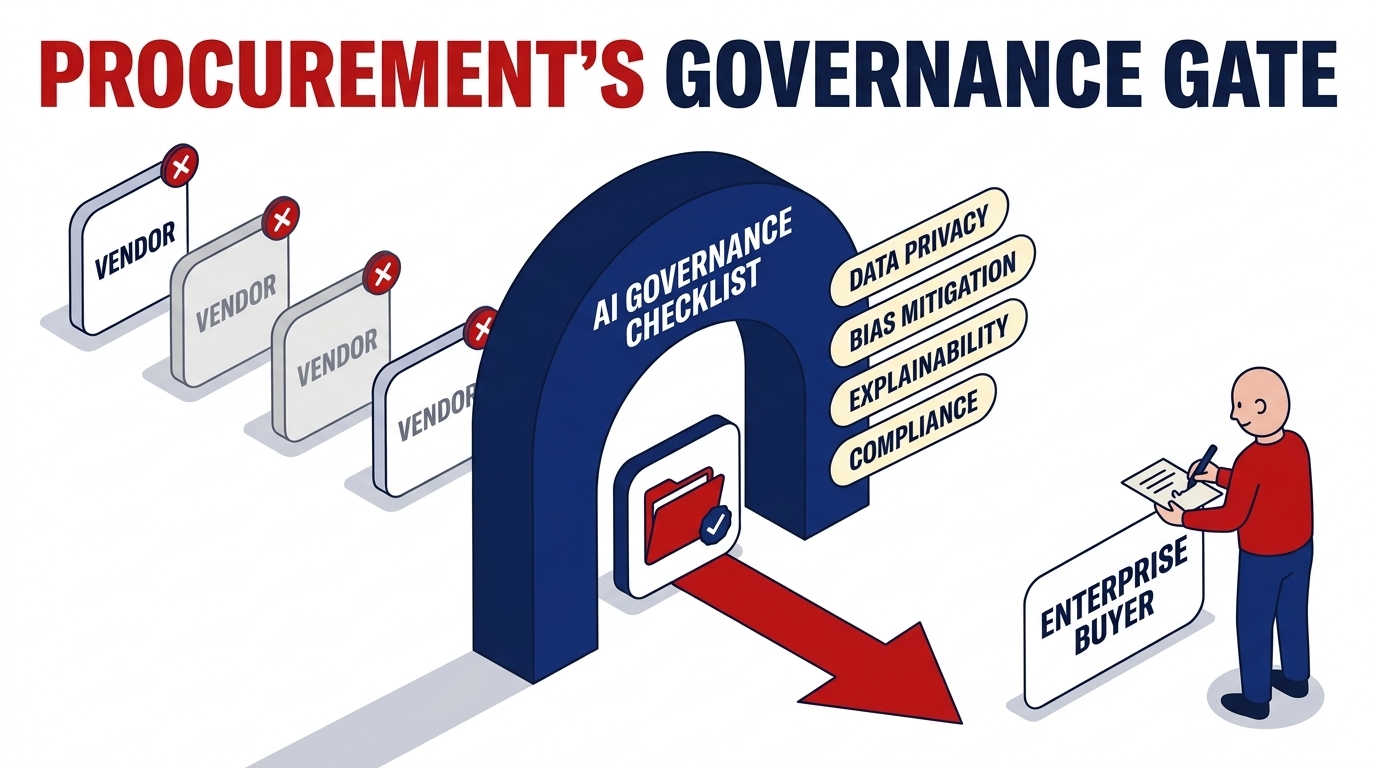
Procurement requirements, not philosophical debates, are pushing UK tech firms towards responsible AI implementation. Enterprise RFPs and public-sector frameworks now routinely demand documented AI risk management as a condition of doing business. Without evidence of governance, mid-market tech firms risk disqualification. This is a commercial gate, not a virtue signal.
Even off-the-shelf tools such as Copilot and ChatGPT attract scrutiny; buyers expect suppliers to show how they control bias, security and transparency. Buyers are no longer asking whether a supplier uses AI; they are asking for the record that shows how it is controlled, and a structured AI risk management framework is what turns that question from an obstacle into a differentiator. When a compliance manager can attach a structured governance record to a bid, the firm moves from reactive explanation to proactive qualification. That practical readiness also strengthens commercial credibility, protecting pipelines in a market where procurement teams now filter on responsible AI adherence before evaluating feature lists. As commercial pressure intensifies, the regulatory dimension of the EU AI Act adds a further layer of obligation.
|
58%
of executives say responsible AI improves ROI and efficiency (PwC)
|
40%
of enterprise apps will include task-specific AI agents by 2026 (Gartner)
|
$12.9m
the minimum annual cost of poor data quality to an organisation (Gartner)
|
EU AI Act: Extraterritorial Reach and Compliance Timelines
Building on this commercial pressure, the EU AI Act applies extraterritorially: UK tech firms supplying AI systems to the EU must classify risk, meet transparency obligations and observe enforcement milestones that are already running, or face penalties severe enough to reshape a growth-stage business. The Act’s risk categories reach across typical product lines. High-risk classifications can attach to recruitment tools, credit-scoring algorithms or biometric systems, leaving many mid-market tech teams unaware of their exposure.
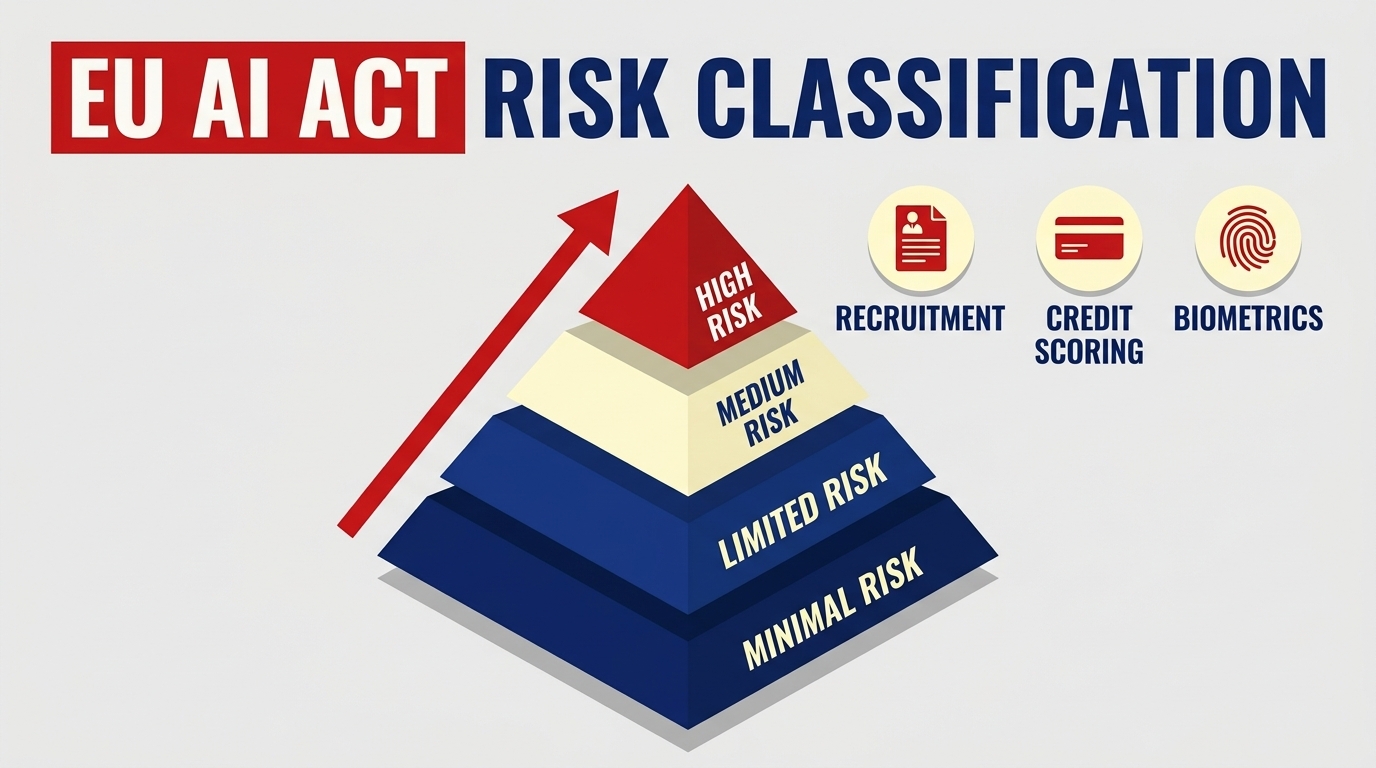
Mapping AI use cases now creates the evidential backbone for EU AI Act compliance in the UK, and demonstrates the seriousness that enterprise clients expect. Without a structured inventory of models, data flows and decision logic, firms lack the documentation to respond to a regulatory inquiry or a procurement questionnaire. The timelines are already running: the Act’s prohibitions and general-purpose transparency duties are in force now, and the high-risk obligations follow, so the preparatory work of classification, conformity assessment and technical documentation needs to be underway rather than scheduled. Understanding the regulatory map is only half the battle; the operational how-to of governance relieves the practical burden.
Assuming off-the-shelf tools are exempt
What happens: Firms believe that using Copilot or ChatGPT does not require risk management documentation. Many enterprise RFPs now explicitly ask for evidence of AI governance even for these tools, leading to surprise disqualification.
What to do instead: Treat all AI components, internal or third-party, as in scope for risk classification. Build a model inventory and maintain evidence of bias testing and transparency measures for every system used in client-facing workflows.
Governance as a Capacity Booster
In practice, early AI governance reclaims capacity: automated compliance checks and structured risk assessments turn governance from an overhead into a capacity booster, freeing hours lost to manual due diligence, RFP response drafting and ad hoc compliance queries. Tech teams that design governance as a repeatable workflow rather than a one-off project discover that the discipline itself becomes a production asset.
Floodlight builds this as connected workflow rather than a document library, capturing and routing vendor-assessment evidence automatically; clients report faster qualification and reclaimed team time once governance validation and scored routing are configured. When AI risk management is integrated into the operational rhythm through templated assessments and pre-built documentation, the team spends less time chasing artefacts and more time on product development. This shift illustrates one of the practical benefits of AI implementation: governance, done early, stops being a brake on speed and starts behaving like a force multiplier for trust.
Which specific activities free up the most capacity?
Manual vendor due diligence, RFP response drafting and ad hoc compliance requests are the three areas where automation delivers the fastest relief. Standardised risk-assessment templates and connected data sources allow a compliance manager to pull a model card or a bias-audit record in minutes instead of hours, while pre-configured evidence packs answer the typical governance sections of an RFP without a fresh scramble. Structuring these tasks onto a recognised framework turns sporadic effort into systematic proof.
Not sure which of your AI systems are in scope?
Book a 30-minute call and we will walk your current AI stack, flag what a procurement questionnaire or the EU AI Act would classify as high-risk, and show you what evidence you are missing. You leave with the list, whether or not you work with us.
Book a 30-minute callUsing the NIST AI Risk Management Framework
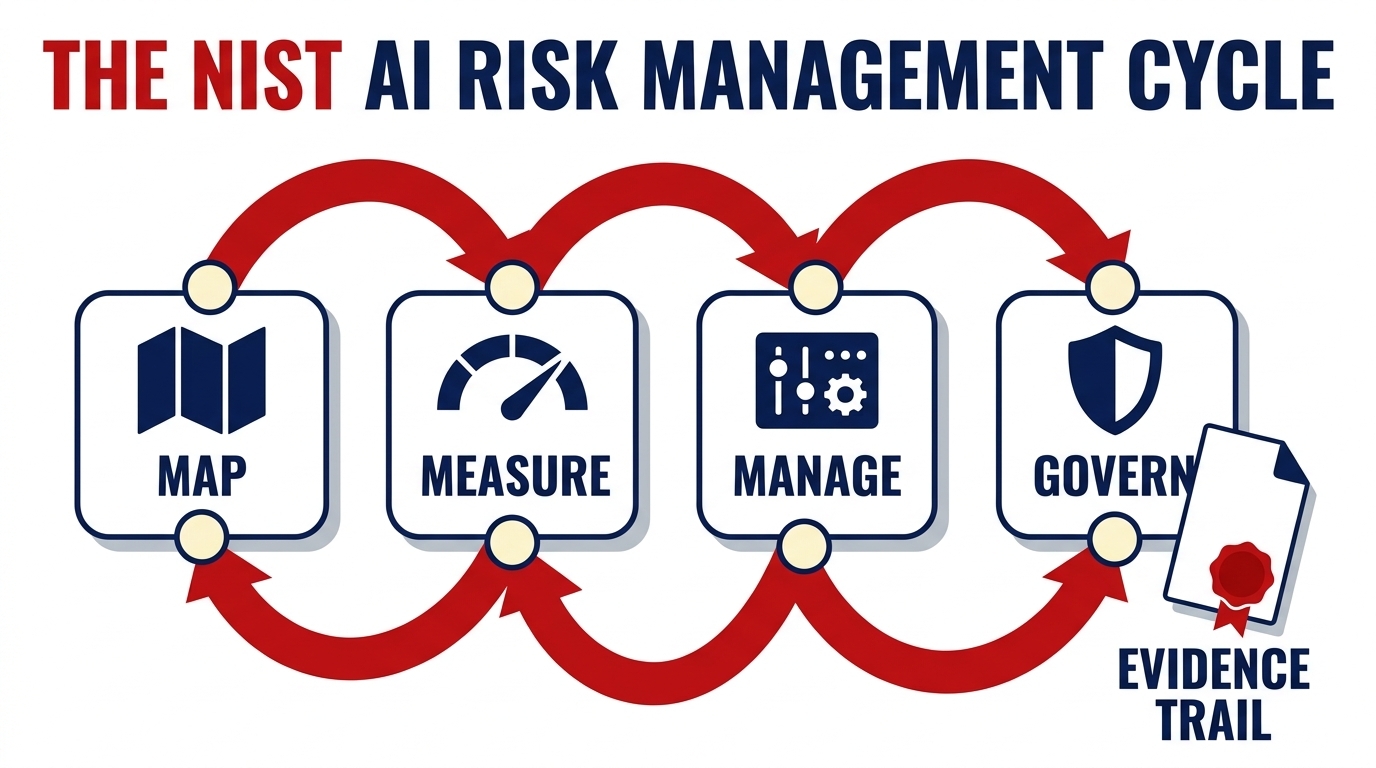
The next layer, adopting the NIST AI Risk Management Framework, gives technology teams a structured methodology to map, measure, manage and govern AI risks. That process creates the evidence trail enterprise procurement requires and shortens the preparation time for governance-heavy bid submissions, not because the paperwork is simpler, but because the documentation is already current and organised.
The NIST AI RMF’s four functions, Map, Measure, Manage and Govern, align naturally with EU AI Act expectations and enterprise risk-management language, helping a mid-market tech firm demonstrate due diligence without inventing a bespoke system. When the same framework underpins both product development and sales documentation, the team answers RFP governance sections with consistent, defensible evidence. This approach to AI governance turns an AI risk management framework from a compliance artefact into a commercial asset: a vendor-ready posture that translates responsible principles into contract-winning readiness.
Conclusion
Procurement mandates and the EU AI Act have turned responsible AI governance from a philosophical stance into a commercial qualification for technology firms. For mid-market tech teams, acting early means reclaiming the hours lost to manual due diligence and reactive RFP drafting, once risk assessments and evidence capture are automated into a repeatable workflow. That capacity returns to product development and bid-winning activity, while a structured framework like the NIST AI RMF provides the vendor-ready documentation that keeps you in the running for enterprise deals.
Frequently Asked Questions
What is responsible AI implementation?
Responsible AI implementation means deploying artificial intelligence systems that are transparent, fair, accountable, and aligned with ethical guidelines. For technology teams, it involves embedding governance from design through deployment to ensure models respect privacy, avoid bias, and remain explainable while delivering business value.
How does responsible AI implementation work for technology businesses?
It works by integrating ethical checkpoints into the AI development lifecycle. Technology businesses establish review boards, use bias detection tools, and document model decisions. Automated testing and continuous monitoring ensure systems behave as intended, while clear accountability structures help teams identify and correct issues quickly before they impact users.
What are the main benefits of responsible AI implementation for technology companies?
Key benefits include reduced regulatory risk, stronger customer trust, and fewer costly model failures. Technology companies see improved model accuracy through bias mitigation and gain a competitive edge by demonstrating ethical commitments. Responsible practices also help attract talent and simplify compliance with emerging AI legislation across global markets.
Is responsible AI implementation right for technology startups building internal AI tools?
Yes, even small technology teams benefit. Starting with lightweight governance frameworks and open-source fairness toolkits helps startups build AI that scales safely. It’s crucial if your tools handle sensitive data or automate decisions, as early responsibility reduces rework and builds a foundation for future growth.
Find your AI governance gaps before a buyer does
The AI Enhancement Audit maps every AI system in your business against the evidence enterprise procurement and the EU AI Act actually ask for, and hands you a prioritised remediation list you can attach to your next bid. Fixed fee, £997.
Book a discovery call