
AI Ethics Risk Management for Tech: A Practical Guide
Enterprise AI ethics risk management means identifying, assessing and mitigating the harms AI systems can cause, from biased outputs and opaque decisions to data privacy failures. For technology firms, a structured framework covering governance, model auditing and named accountability reduces regulatory exposure and builds the buyer trust enterprise sales cycles depend on.
For UK technology firms, documented AI ethics risk management is now a condition of competing for enterprise contracts and a commercial asset when built into day-to-day workflows.
- Procurement requirement: In regulated sectors, AI governance is increasingly assessed at RFP stage, often before product capability enters the conversation.
- Frameworks give structure: NIST AI RMF, ISO 42001 and the EU AI Act turn abstract ethics principles into documented, assessable outputs.
- Human-in-the-loop by design: Confidence thresholds, bias flagging and manual routing make AI-powered CRM workflows auditable and defensible.
- Documentation shortens deals: A prepared AI ethics pack, covering risk register, framework rationale and audit trail, reduces vendor due-diligence cycles.
- Built in, not bolted on: Floodlight configures review controls at setup, so the governance documentation you hand to procurement reflects how the workflow actually runs.
Why AI ethics moved from compliance chore to procurement gate
For UK technology firms scaling AI-powered automation, enterprise AI ethics has moved from a compliance consideration to an active procurement requirement. Enterprise buyers, particularly in regulated sectors, are asking vendors to demonstrate AI governance practices before contracts are signed. Firms without documented frameworks are not simply at regulatory risk; they are losing deals to competitors who have already done the work.
The conventional response has been to treat ethics as a retrospective audit: deploy first, document later. That approach is no longer adequate. Where an enterprise RFP carries an AI governance section, procurement teams ask specific questions about bias controls, transparency and accountability before due diligence even begins. A mid-market UK technology firm that cannot produce a documented risk management approach at that stage is already at a disadvantage regardless of what its product actually does.
Embedding AI governance into CRM and automation workflows from the outset changes that calculus. Human-in-the-loop review points, bias flagging, and confidence-score thresholds are not obstacles to performance. They are design choices that make AI systems more reliable and easier to defend under scrutiny. Floodlight clients report faster lead qualification and reclaimed marketer time once governance validation and scored routing are configured. This guide sets out a practical route for technology firms to build that case.
Why is enterprise AI ethics becoming a procurement requirement for UK technology firms?
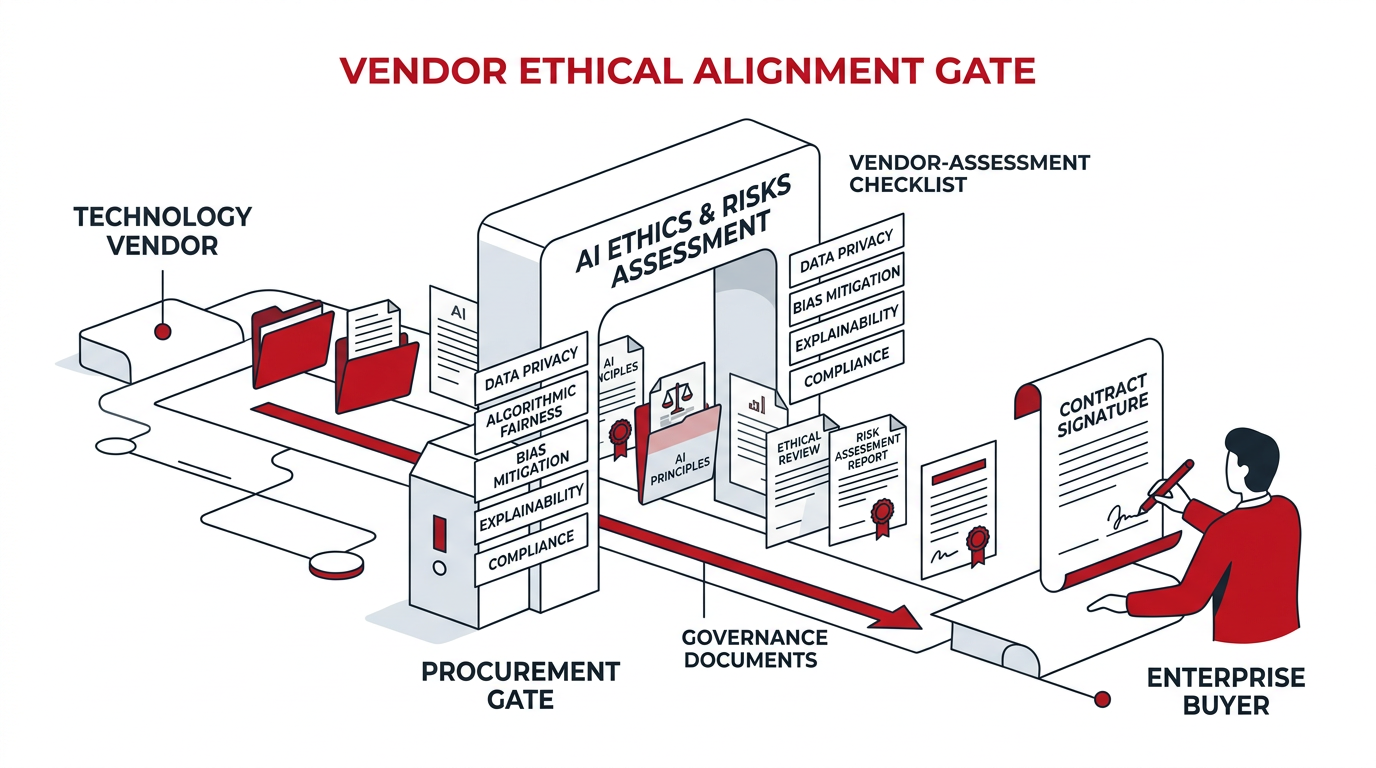
Enterprise buyers now require documented AI governance before contracts are signed because procurement processes, especially in regulated sectors, have shifted from retrospective audit to pre-contract assessment. Bias controls, transparency practices, and accountability structures are evaluated at RFP stage, before product capability is even considered.
This shift is most pronounced in financial services, healthcare, and energy, where regulated buyers face their own compliance obligations and cannot accept undocumented AI risk from vendors. Procurement teams are asking specific questions: how are scoring models audited, who owns accountability when an AI decision is challenged, and what controls prevent demographic or firmographic bias from skewing results? Technology vendors without prepared answers are disadvantaged regardless of product quality. The assessment moves on before the conversation about capability begins.
The commercial stakes are clear. In PwC's 2025 Responsible AI survey, 58% of executives said responsible-AI initiatives improve ROI and efficiency. For mid-market UK technology firms, that finding translates directly: AI ethics risk management, and a documented AI governance framework UK firms can present at RFP stage, is no longer compliance overhead but a condition for competing.
What do UK AI regulations and global frameworks actually require from technology vendors?
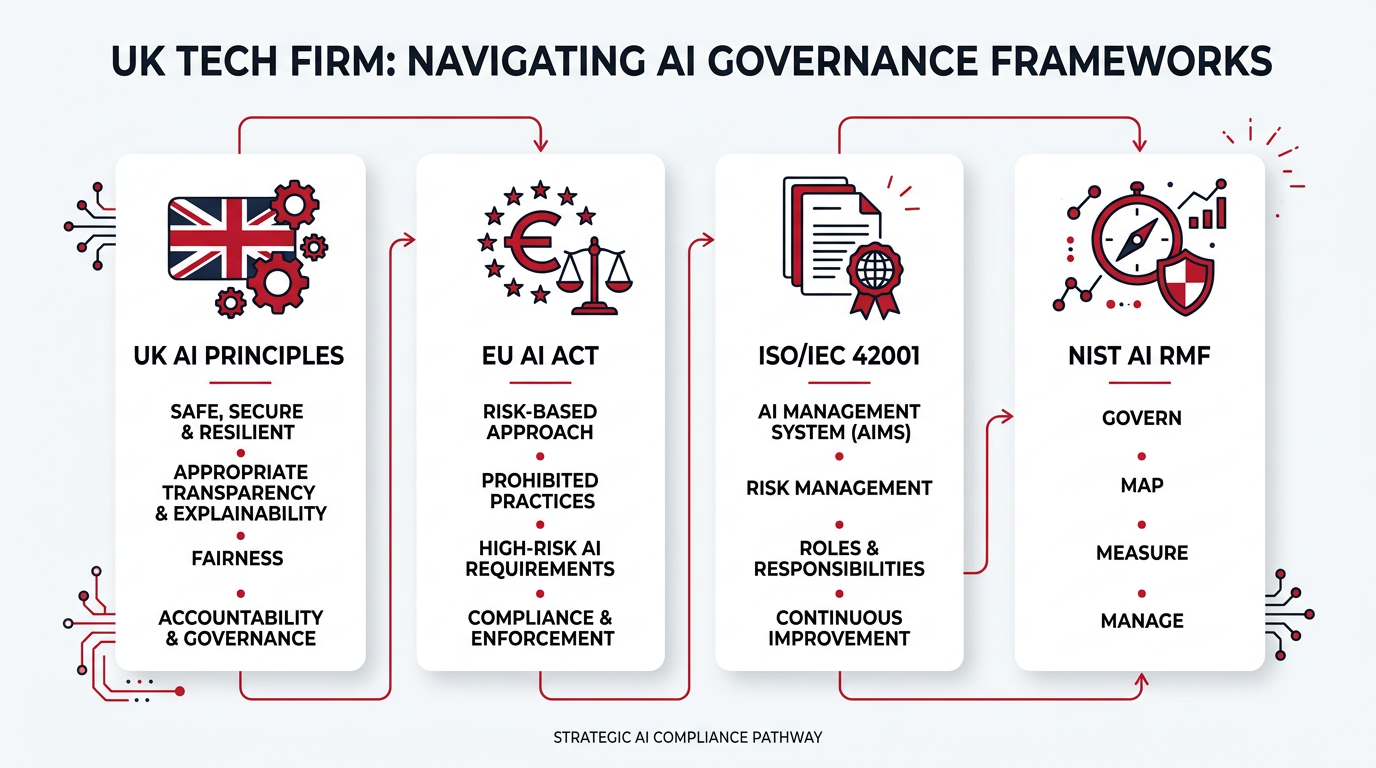
Three frameworks define what technology vendors must produce or demonstrate: NIST AI RMF provides a voluntary but widely adopted risk-mapping structure; ISO 42001 is a certifiable management system standard for AI; and the EU AI Act is a binding legislative instrument with extraterritorial reach. Together, they require documentation, risk classification and named accountability, not abstract principles.
Gartner predicts 40% of enterprise applications will include task-specific AI agents by 2026, up from less than 5% in 2025, which is why supplier questionnaires now reach past the product and into how those agents are governed. ISO 42001 is the only one of the three that is certifiable, so it is the one a buyer can ask you to evidence with a certificate rather than a policy document. Selecting the right AI governance framework, one UK technology firms can apply directly to their supplier processes, is therefore a practical commercial decision rather than a theoretical one.
Floodlight maps client AI workflows against these structures during CRM and automation configuration, making framework alignment a built-in step rather than a retrospective exercise.
How does NIST AI RMF apply to UK technology firms?
NIST AI RMF is US-origin but widely referenced in international B2B technology procurement. Its four core functions, Map, Measure, Manage and Govern, translate into practical risk-mapping activities a UK vendor can carry out without a large compliance team. Mapping identifies where AI is used; Measuring assesses risk severity; Managing applies controls; Governing assigns accountability. Each function produces documented outputs that satisfy enterprise supplier questionnaires.
What does EU AI Act compliance mean for UK technology vendors post-Brexit?
If a UK technology firm's product or service is deployed by an EU-based organisation or processes data from EU users, the EU AI Act applies regardless of where the vendor is incorporated. The Act classifies AI systems into four risk tiers: unacceptable, high, limited and minimal. High-risk systems face the strictest documentation, testing, and audit requirements. Responsible AI deployment for UK vendors selling into EU accounts requires understanding which tier their systems fall into before procurement questions arise.
How can technology firms assess and prioritise AI risk across their product and go-to-market operations?
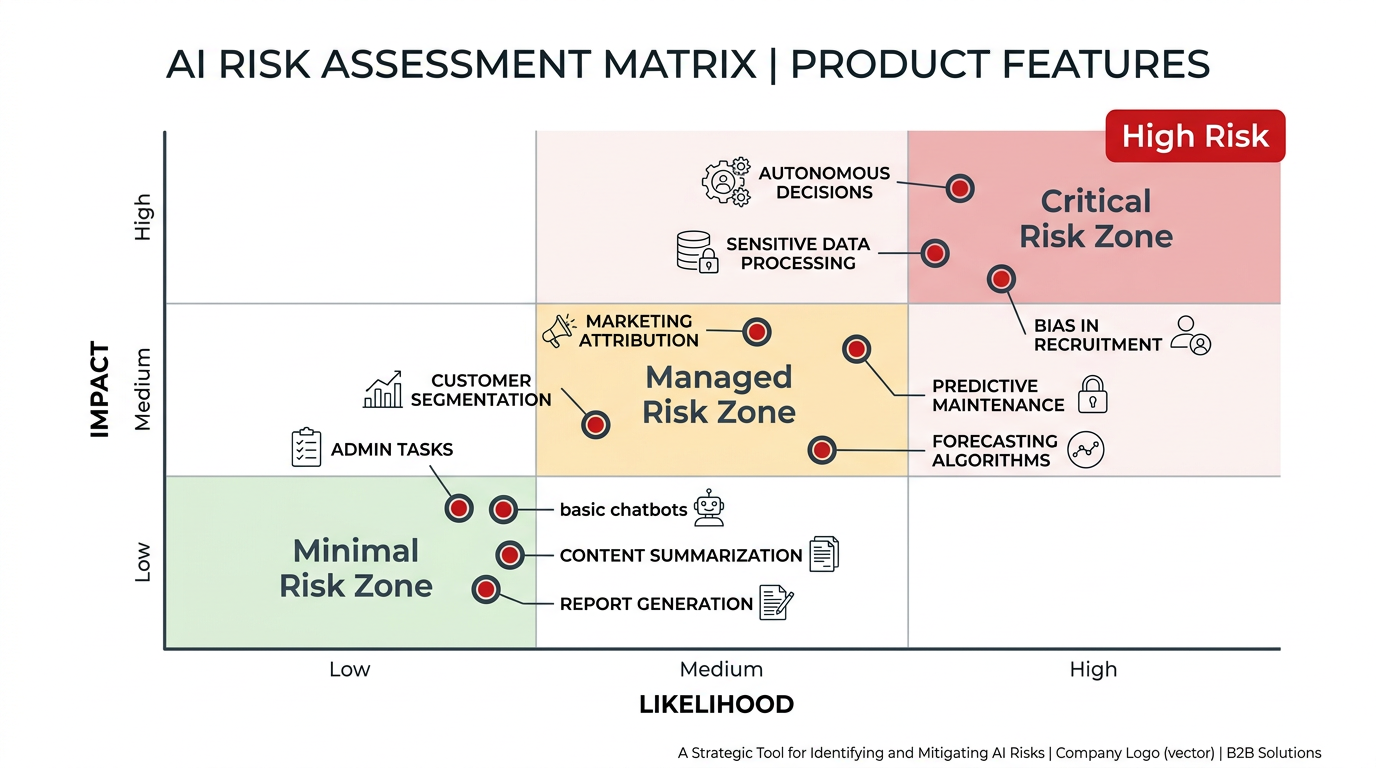
Technology firms should begin by mapping every AI touchpoint across product and commercial operations, then classify each by impact level and data sensitivity before scoring likelihood of harm or bias. This structured sequence produces a prioritised list of risks that can be addressed in order of severity.
The four-step approach runs as follows: first, inventory all AI touchpoints, including product features, CRM scoring, lead qualification and automated outreach; second, classify each by impact level and data sensitivity; third, score likelihood of harm or bias using a simple matrix; fourth, prioritise remediation or control design for the highest-rated risks. Applying a documented AI risk management framework to each touchpoint in the product and go-to-market stack produces a risk register that can be shared directly with enterprise procurement teams.
The four-step approach runs as follows:
- Inventory all AI touchpoints. Product features, CRM scoring, lead qualification and automated outreach.
- Classify each one: by impact level and data sensitivity.
- Score the likelihood of harm or bias: using a simple matrix.
- Prioritise remediation or control design: for the highest-rated risks.
Applying a documented AI risk management framework to each touchpoint in the product and go-to-market stack produces a risk register that can be shared directly with enterprise procurement teams.
CRM and lead qualification workflows are common sources of algorithmic bias when confidence thresholds are not configured deliberately. Firmographic patterns can then skew scoring in ways that are invisible without audit logging. The inputs matter as much as the model: according to Gartner, poor data quality costs organisations at least £9.54 million or $12.9 million per year, and the same weak inputs are what push a scoring model off course. Skipping this step is not a time-saving measure. It is where the deployment comes apart under scrutiny.
Treating AI governance as a retrospective audit
What happens: Firms that deploy first and document later cannot produce a risk management approach when procurement teams ask at RFP stage, and the assessment moves on before product capability is discussed.
What to do instead: Map AI touchpoints and classify risk before deployment. Build review points into CRM and automation workflows at configuration stage, so governance documentation reflects live practice rather than a historical reconstruction.
Building AI governance into your tech stack?
Floodlight embeds human-in-the-loop controls, confidence thresholds and bias flagging into your CRM and automation workflows, so a vendor assessment finds documentation that matches how the system actually runs.
Book an AI governance reviewHow should human-in-the-loop controls be configured in AI-powered CRM and automation workflows?
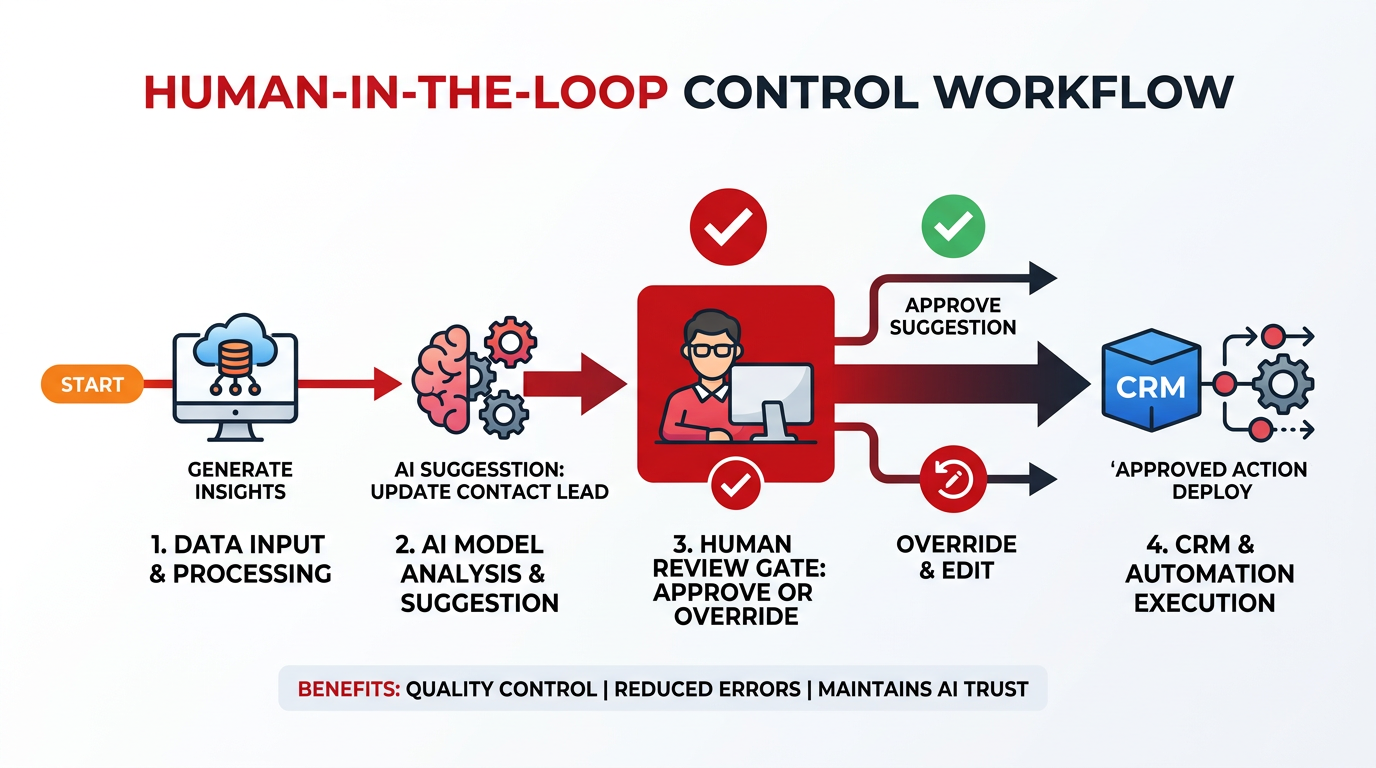
Human-in-the-loop controls belong at three specific points in AI-powered CRM and automation workflows: confidence-score thresholds, bias flagging, and manual routing for edge cases. These are design choices that improve reliability: each one makes the workflow more auditable and easier to defend under enterprise scrutiny.
Confidence-score thresholds route leads below a defined confidence level to human review rather than automated progression. Bias flagging identifies demographic or firmographic patterns that skew qualification scores and holds the record before it advances. Manual routing provides a defined escalation path for anomalies. Together, these controls make every decision point logged and attributable, which is precisely what enterprise procurement teams examine during AI accountability assessments.
Floodlight configures bias flagging and confidence-score thresholds directly within HubSpot and n8n workflows as part of standard setup, making governance a built-in feature rather than a retrospective addition.
Where should review points sit inside a lead qualification workflow?
Human-in-the-loop checks are most valuable at three stages: first, initial data ingestion: verify that input fields used for scoring are complete and unbiased before the record enters the model; second, the scoring threshold gate: flag and hold records that score below the agreed confidence level; third, handoff to sales: require a human confirmation step before a lead is marked sales-qualified. Each stage produces an audit log entry that supports AI transparency and accountability requirements.
How does documented AI governance help UK technology firms win enterprise contracts faster?
Documented AI governance shortens vendor due diligence by removing the back-and-forth that occurs when procurement teams ask questions vendors have not prepared for. Firms with answers already in place pass the assessment stage faster, because prepared documentation replaces reactive explanation.
Enterprise RFPs now include specific questions on bias controls, model transparency, and accountability ownership. The PwC finding cuts both ways here: the firms winning contracts are using ethics documentation as an active procurement asset, not a compliance by-product.
A prepared AI ethics pack covering risk register, framework selection rationale, and workflow audit trail can be shared directly with procurement teams, reducing the assessment cycle materially. Audit trails created during HubSpot CRM integration become part of the vendor evidence pack, connecting governance documentation to the systems already in use. Floodlight supports technology clients in preparing this documentation, including risk registers, framework mapping and audit trails, as part of CRM and automation deployment, so firms arrive at procurement conversations already prepared. The same audit trail that satisfies a procurement questionnaire is the one your own team uses to see why a lead was scored the way it was.
What does a practical AI ethics implementation roadmap look like for a mid-market UK technology firm?
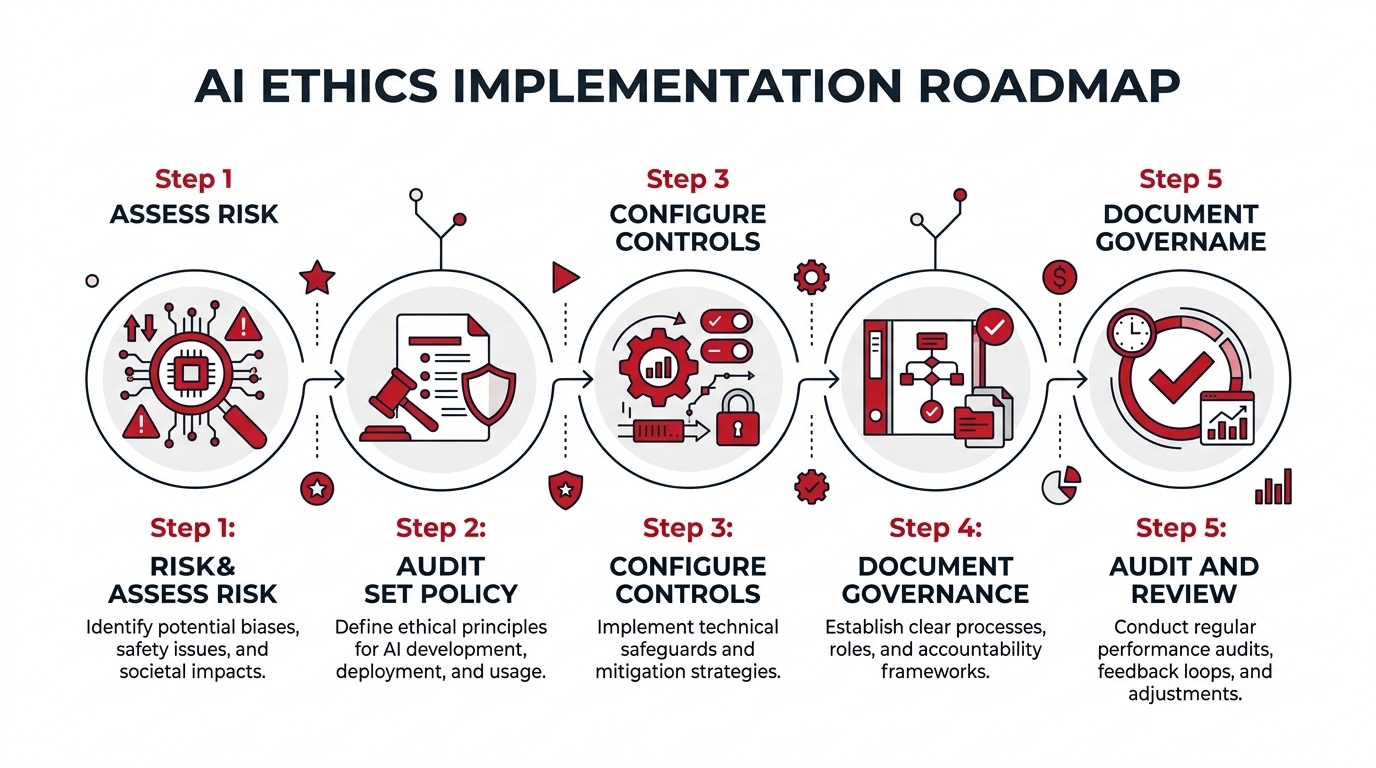
A practical AI ethics implementation follows four phases: framework selection, internal audit, workflow configuration, and documentation readiness. Each phase builds on the last, and a focused mid-market firm can typically complete the first two in four to six weeks.
- Framework selection: choose between NIST AI RMF, ISO 42001, or a combined approach based on where the firm sells and what enterprise buyers are asking. A firm selling into regulated EU markets will need to account for EU AI Act compliance requirements; one competing primarily on UK public sector contracts may prioritise ISO 42001 certification.
- Internal audit: inventory all AI touchpoints across product, CRM, and go-to-market operations, classify each by risk tier, and assign named accountability owners. This step produces the risk register that underpins all subsequent documentation.
- Workflow configuration: embed human-in-the-loop controls, confidence thresholds, and bias flagging into CRM and automation systems. Responsible AI deployment requires these controls to be built in at configuration, not added after deployment.
- Documentation readiness: produce a risk register, a framework rationale document, and an audit trail formatted for sharing with procurement teams. These three artefacts address the most common questions in enterprise supplier assessments.
Governance documentation is not a one-time output. It should be reviewed and updated whenever models, data inputs or workflows change, so that the governance framework you present to buyers reflects current practice, not a historical snapshot.
Frequently Asked Questions
What is enterprise AI ethics?
Enterprise AI ethics is a structured approach to identifying, assessing and managing the risks created by AI systems in business contexts. For technology companies, it covers fairness, transparency, accountability and data governance across every AI-powered product or internal tool, ensuring decisions made by algorithms meet legal, regulatory and stakeholder expectations.
How does enterprise AI ethics work for technology businesses?
Technology businesses implement enterprise AI ethics through a combination of risk frameworks, model auditing, bias testing and governance policies. In practice, teams map each AI system to potential harms, assign accountability owners, document decision logic, and review outputs regularly against agreed ethical standards before deployment and throughout the model's operational life.
What are the main benefits of enterprise AI ethics for technology companies?
Technology companies that embed AI ethics reduce regulatory exposure, build customer trust and catch costly model failures earlier. Concrete outcomes include fewer compliance incidents, faster sign-off from legal and procurement teams, stronger positioning in enterprise sales cycles where buyers now routinely audit suppliers' AI governance credentials before awarding contracts.
How long does enterprise AI ethics take to implement?
A foundational enterprise AI ethics programme typically takes three to six months to implement across a technology organisation. That covers risk framework design, policy documentation, team training and initial model audits. Ongoing governance is continuous, but most companies reach a workable baseline within one quarter once executive sponsorship and a dedicated working group are in place.
Enterprise AI ethics vs AI compliance: what is the key difference?
AI compliance meets minimum legal requirements; enterprise AI ethics goes further by addressing harms that are not yet regulated. Compliance is reactive and binary: pass or fail. Ethics is proactive and contextual, asking whether an AI system is fair and explainable even when no specific law compels you to act.
Is enterprise AI ethics right for technology companies building AI-powered products for regulated sectors?
Yes. Technology companies building AI products for healthcare, financial services or public sector clients face direct scrutiny of their AI governance practices from buyers and regulators alike. Enterprise AI ethics gives those companies the documented controls, audit trails and accountability structures needed to win and retain contracts in heavily regulated client environments.
Find out where your AI governance actually stands
The AI Enhancement Audit is a fixed-fee £997 review of your CRM and automation stack: where AI touches a decision, which controls are missing, and what an enterprise buyer will ask you to evidence. You finish with a risk register, a framework rationale and an audit trail you can hand to procurement.
Book a discovery call