

For Marketing Ops teams, digital marketing is an integrated source-to-revenue system, not a channel list. It only produces measurable pipeline when every channel feeds into a configured CRM, whether HubSpot or Pardot, with attribution modelling, lead scoring, UTM tracking and routing rules defined before campaigns go live.
Digital marketing only produces a measurable pipeline for B2B companies when channels are connected to a configured data layer in the CRM. Attribution models, scoring rules and routing logic must all be in place before campaigns go live.
- Integration first: Channels operating without a mapped CRM data layer produce activity logs, not attribution. Connecting that activity to closed revenue requires deliberate configuration.
- Marketing Ops carries the structural weight: Lead scoring, routing, and attribution modelling sit within the Marketing Ops function. These systems determine whether digital spend is defensible.
- Attribution requires a prerequisite sequence: Attribution model, UTM structure, scoring rules, and routing logic must all be defined in HubSpot or Pardot before campaigns launch. Retrofitting them after spend has accumulated leaves the early data unrecoverable.
- Automation recovers capacity: Routing, scoring updates and attribution reporting run on rules rather than on someone remembering to run them, which is where the reclaimed hours come from and why the data stays consistent.
- The diagnosis is precise: If you cannot trace every closed deal to its originating digital channel without a manual data exercise, the problem is the integration layer, not the channel mix or budget level.
Introduction
Most digital marketing guides for Marketing Ops teams open with a channel list, naming SEO, PPC, email and social, and stop there. The problem is that channels without a connected data layer produce activity logs, not attribution. For B2B companies in the UK mid-market, this distinction matters more than most guides acknowledge: unattributed spend is not a reporting inconvenience, it is a structural failure that makes every budget conversation harder and every campaign decision less defensible.
The conventional approach treats digital marketing as a creative and channel-selection problem. In 2026, that framing is demonstrably insufficient. HubSpot and Pardot configurations that map source-to-revenue across every touchpoint have made it possible to see exactly which channels generate a qualified pipeline and which generate noise. Companies that have not built that data layer into their CRM before campaigns go live are not running digital marketing, they are running spend with incomplete feedback.
This is where Marketing Ops carries the structural weight. The systems that make digital channels measurable, which are lead scoring, routing and attribution modelling, sit within the Marketing Ops function rather than the campaign team. Floodlight clients report faster lead qualification and reclaimed marketer time once governance validation and scored routing are configured into their existing stack. The sections below break down what digital marketing comprises as an operational system, and what needs to be in place before any channel produces numbers worth trusting.
Digital marketing as an operational system
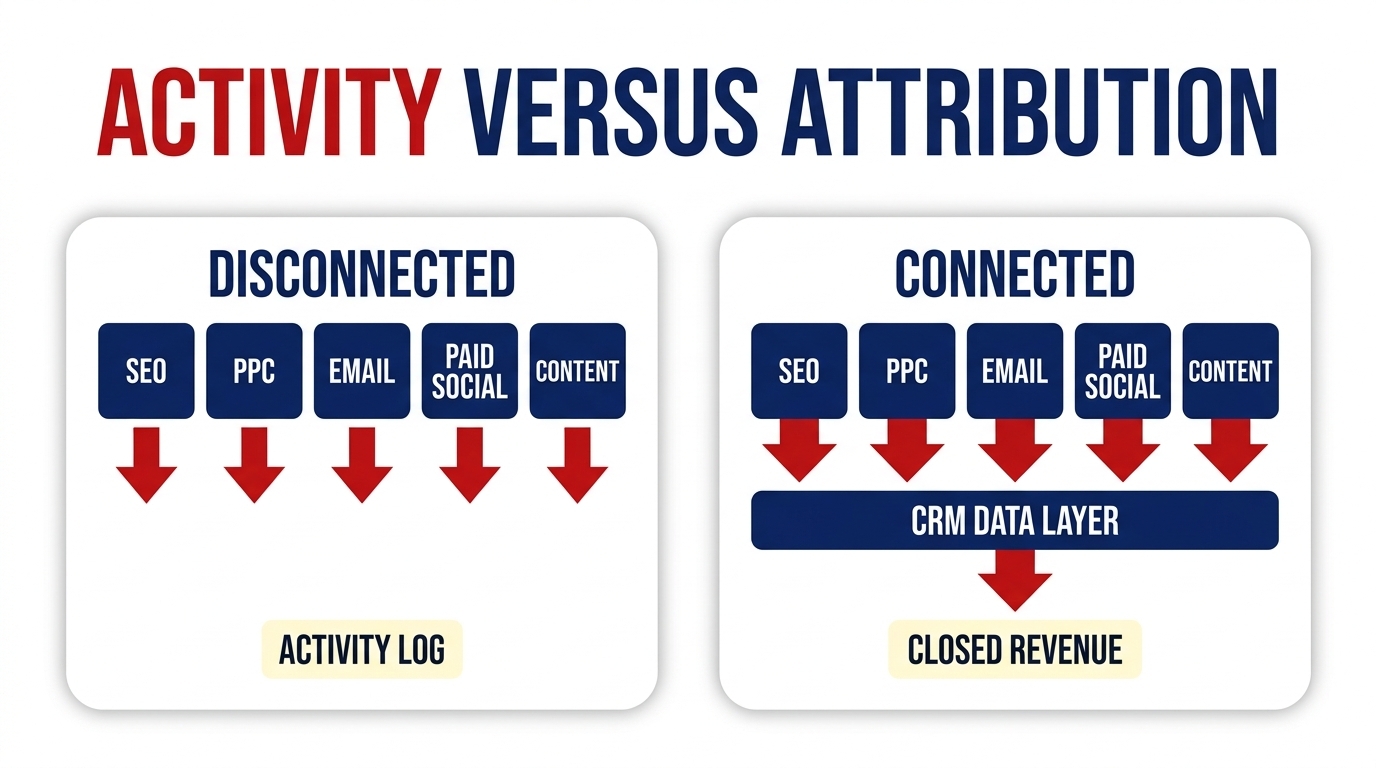
For B2B companies, digital marketing is not a channel menu; it is an integrated source-to-revenue system. SEO, PPC, email, paid social, and content only produce measurable value when each channel is connected to a data layer that traces activity back to revenue. Without that connection, channels generate metrics in isolation rather than a shared attribution picture.
In operational terms, an integrated system means each channel feeds data into a CRM, whether HubSpot or Pardot, where that data is mapped, scored and attributed to the pipeline. The distinction between running channels and running channels inside a connected data layer is the distinction between activity and attribution. A company can have active campaigns across every channel and still have no clear picture of which spend is generating a qualified pipeline, because the channel activity and the CRM record are never joined. This is not a niche problem: according to IAB UK, the UK digital ad market reached £35.5 billion in 2024, which underlines how much budget is moving through channels that many B2B teams still cannot attribute to closed revenue. The digital marketing definition that matters for Marketing Ops is therefore not a list of formats, but a description of a connected data system and explaining digital marketing at the channel level alone misses the operational point entirely.
|
$12.9m
the cost of poor data quality to an organisation each year, according to Gartner
|
How each channel connects to pipeline
Each core channel, whether that is SEO and content, PPC, email or paid social, has a distinct role in a connected B2B marketing system, but that role only becomes visible when the channel feeds data into the CRM. Without that connection, each channel produces its own isolated metric rather than a shared attribution overview.
A digital marketing channels overview that stops at channel descriptions misses the integration requirement. Teams that have completed CRM integration and configuration find that mapping each channel as a tracked source is not an optional configuration. It is the prerequisite for any channel analysis to produce defensible numbers. Floodlight configures this as standard practice: attribution model and source tracking defined before campaigns go live, not retrofitted after spend has accumulated.
How do SEO and content marketing feed a qualified pipeline?
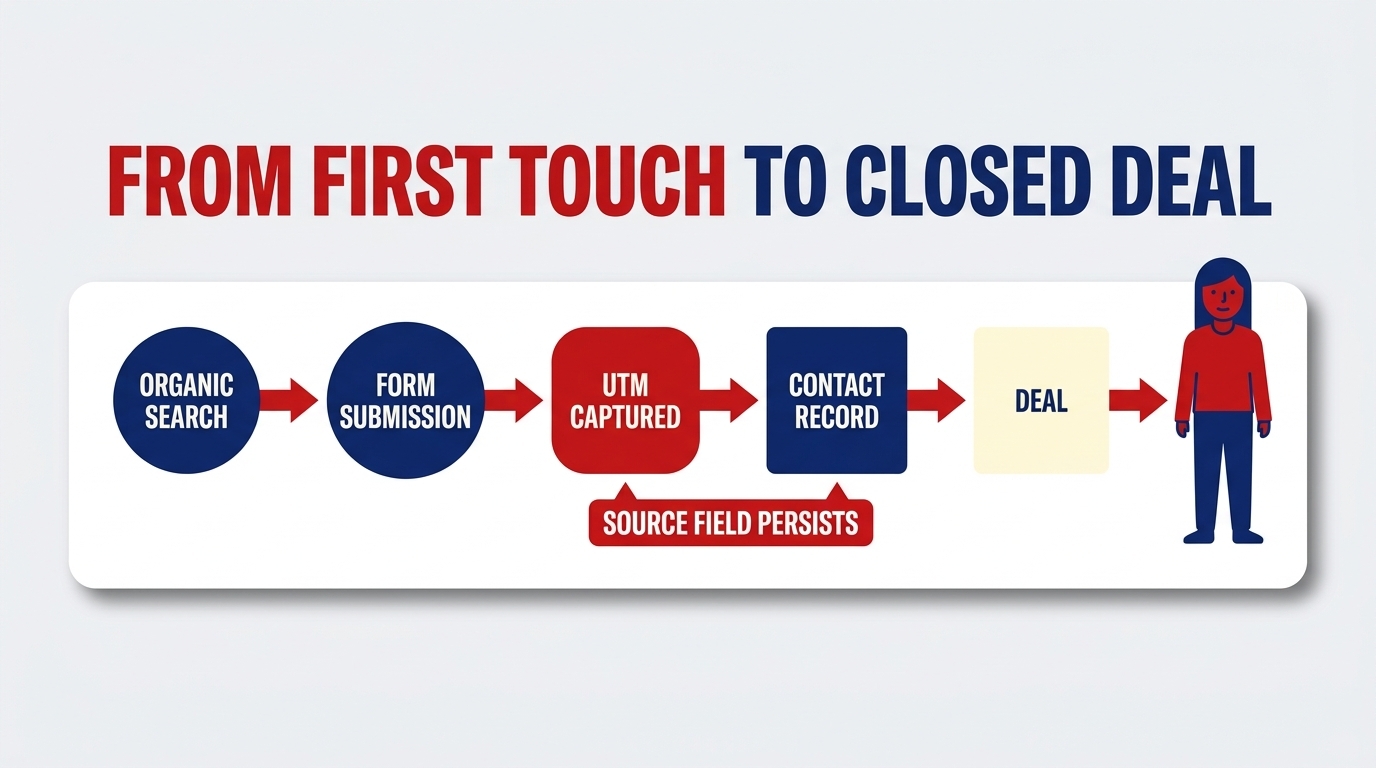
Organic search configured as a tracked source in HubSpot or Pardot means the measure is not session volume; it is qualified leads and influenced deals originating from organic. In a configured CRM, a contact arriving via organic search is tagged at source, and that source field persists through the pipeline. If that contact becomes a closed deal, the originating channel is visible without a manual data exercise. Traffic volume tells you nothing about pipeline contribution; a configured CRM source field does.
How do PPC and paid social contribute beyond clicks?
PPC and paid social attribution requires UTM discipline applied consistently before campaigns go live, combined with deal-level mapping on the CRM side. Platform reporting in Google Ads and LinkedIn shows clicks and impressions, but cannot show revenue attribution. Only when UTM parameters are captured at form submission and mapped to contact and deal records in the CRM does paid spend become traceable to pipeline value. Platform metrics measure activity; CRM-side mapping measures contribution.
Can you trace last quarter's closed deals back to a channel?
If the answer needs a spreadsheet and an afternoon, the gap is in the integration layer rather than the channel mix. The AI Enhancement Audit is a fixed-price review of the CRM and marketing tools you already own: what they hold, where the source data is being lost, and the two or three things worth fixing first. You keep the systems you have.
Book a discovery callHow digital differs from traditional marketing
For a Marketing Ops team, the key difference between digital and traditional marketing is not channel or format but measurability and feedback speed. Digital creates a data trail that traditional marketing cannot produce. The operational implication is that a configured system must exist before campaigns launch, because the data trail is only complete if tracking is built in from the start.
Traditional marketing, meaning print, events and broadcast, produces impressions with limited traceability. Digital marketing produces a traceable data trail from first touch to closed deal, but only when configured correctly. This is where the digital versus traditional marketing distinction matters operationally rather than strategically: the data trail exists in theory for most B2B teams, but the CRM-side configuration to read it is often absent. Access to digital data does not automatically produce attribution. The trail exists in the platforms; whether anyone can read it depends on whether the CRM was configured to receive it, and that configuration is invisible until someone asks which channel produced last quarter's revenue. The digital marketing definition that serves Marketing Ops is therefore one that centres on configuration, not channel selection.
What to fix before the numbers can be trusted
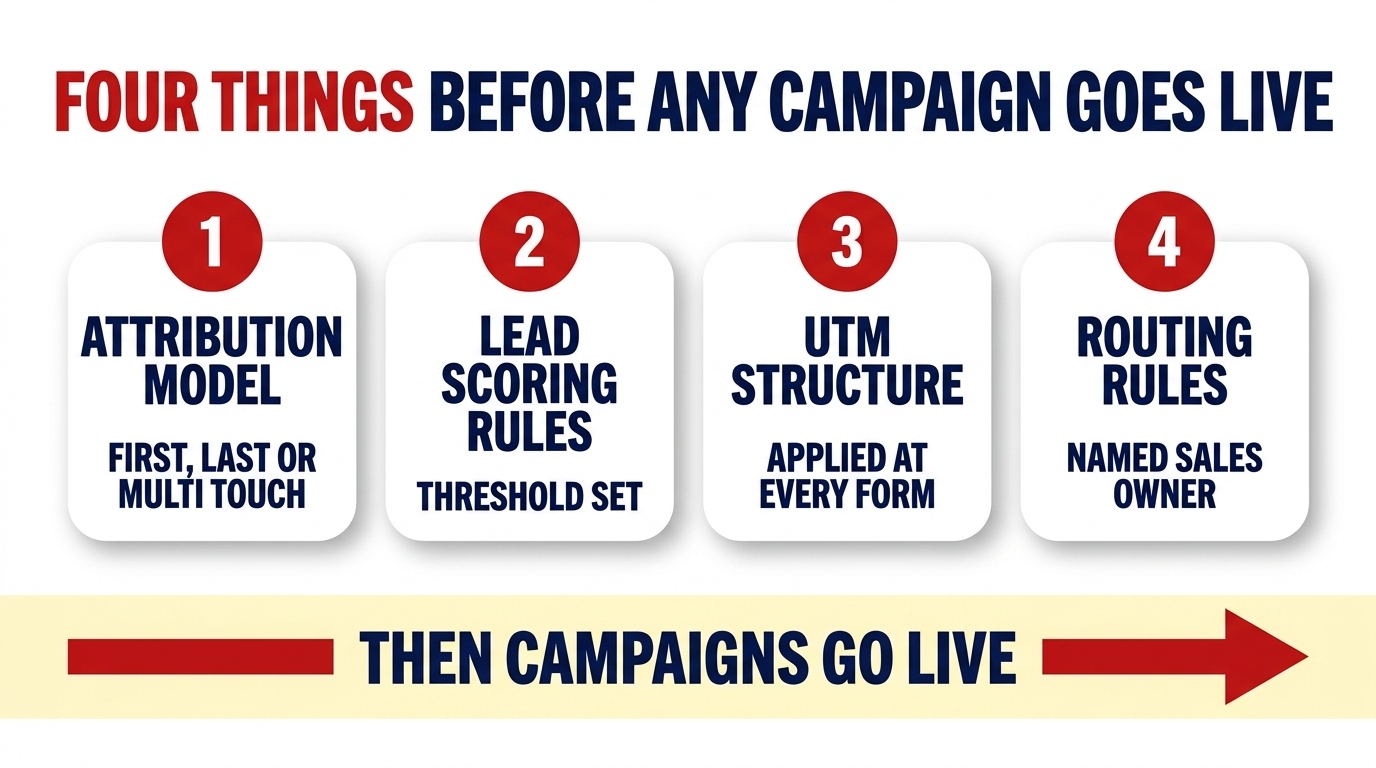
The structural prerequisites are: an attribution model defined in the CRM, lead scoring configured, source tracking mapped across all active channels, and routing rules set. These must exist before campaign spend begins. Configuring them after campaigns have launched means the early data is unrecoverable, and budget decisions made during that period are not defensible.
In concrete terms, the marketing operations framework requires four things. First, an attribution model, whether first touch, last touch or multi-touch, is defined in HubSpot or Pardot before any campaign goes live. Second, lead scoring rules that surface qualified leads from digital channel activity rather than leaving qualification to manual review. Third, a UTM structure is agreed and applied consistently so that source tracking is populated automatically at every form submission. Fourth, routing rules that assign qualified leads to the correct sales representative without manual intervention. The order matters more than the tooling. Source data cannot be recovered for contacts created before tracking was in place, so a team that configures after launch is not late, it is permanently short of the first weeks of evidence. At Floodlight, CRM marketing integration work follows this sequence: attribution model and scoring rules are defined before go-live, not retrofitted after the first reporting cycle reveals gaps.
Configuring attribution after launch
What happens: Attribution models, UTM structures, and scoring rules are treated as reporting tasks rather than prerequisites. Campaigns go live before tracking is built in, leaving the early data permanently incomplete and making budget decisions during that period impossible to defend.
What to do instead: Define the attribution model, agree on the UTM structure, configure scoring rules, and set routing logic in HubSpot or Pardot before any campaign spend begins. The sequence is non-negotiable; there is no way to recover source data for contacts created before tracking was in place.
How lead scoring connects activity to sales
Scoring models that surface qualified leads from digital channels reduce the gap between marketing activity and sales-accepted pipeline. A concrete example: a lead arriving from organic search, downloading a case study, and revisiting a pricing page scores above threshold and is routed to a named sales representative without manual review. The source field is populated automatically; the routing happens without a human checking a spreadsheet. Marketing analytics and attribution are only meaningful when the scoring and routing infrastructure is in place to act on the data the CRM captures.
How automation cuts manual work and improves measurement
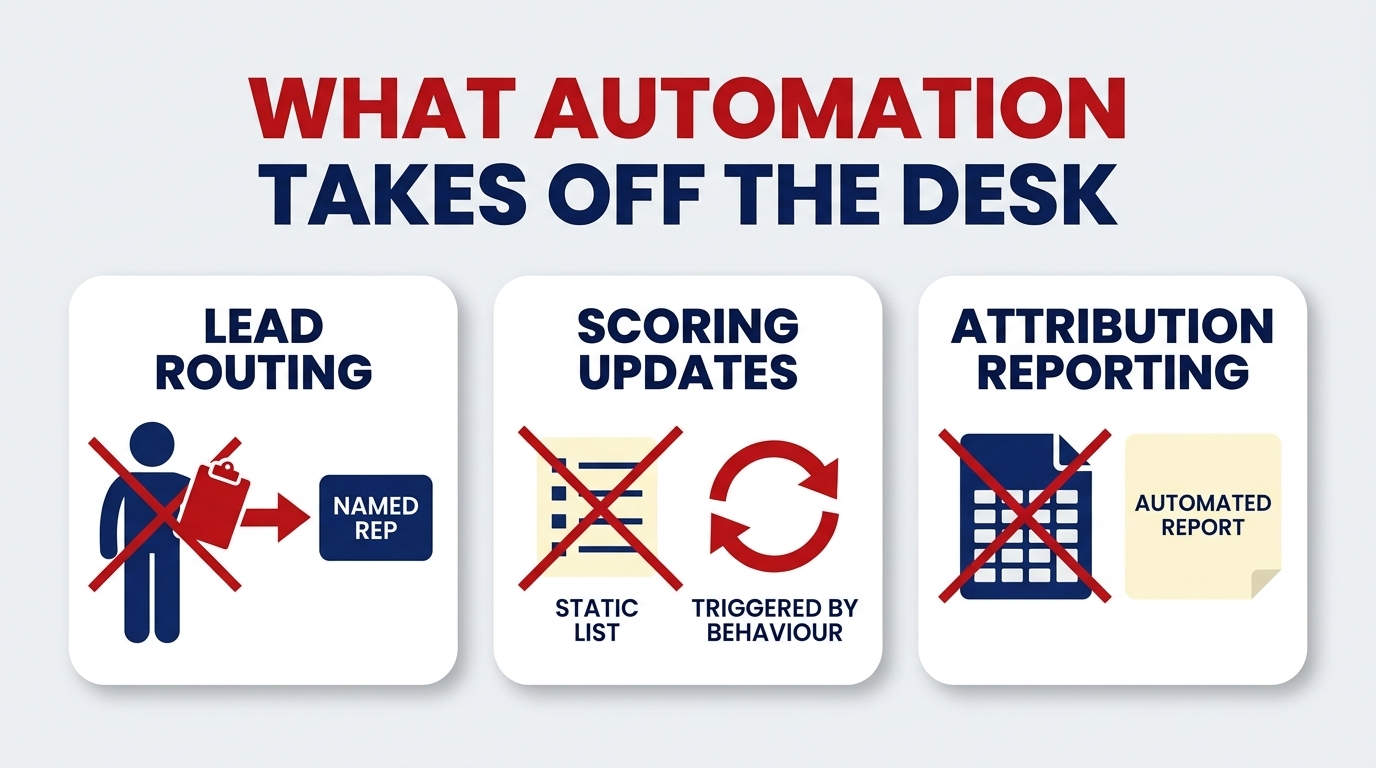
Configured automation in HubSpot, Pardot, n8n, or Make handles the repetitive operational tasks, meaning lead routing, scoring updates and report generation, that consume Marketing Ops capacity when done manually. The result is measurable time recovered and a more reliable data layer, because automated processes apply rules consistently rather than depending on individual manual steps.
The automation functions that most directly improve digital marketing measurement are: automated lead routing that assigns qualified leads to the correct representative without a human checking a spreadsheet; scoring updates triggered by digital channel behaviour so that lead priority reflects current engagement rather than a static list; and automated reporting that surfaces attribution data without manual data pulls each cycle. These are not marginal efficiency gains. As market context rather than a Floodlight result: according to HubSpot's State of Marketing, about a third of marketers say AI saves their team 10-14 hours per week. That recovered capacity is not simply time saved on administration; it is capacity redirected to analysis and campaign decisions. An inbound marketing strategy that depends on manual reporting and manual routing will consistently produce slower feedback and less reliable attribution than one supported by configured automation. The measurement improvement and the time saving are the same mechanism.
How to assess whether your setup produces pipeline
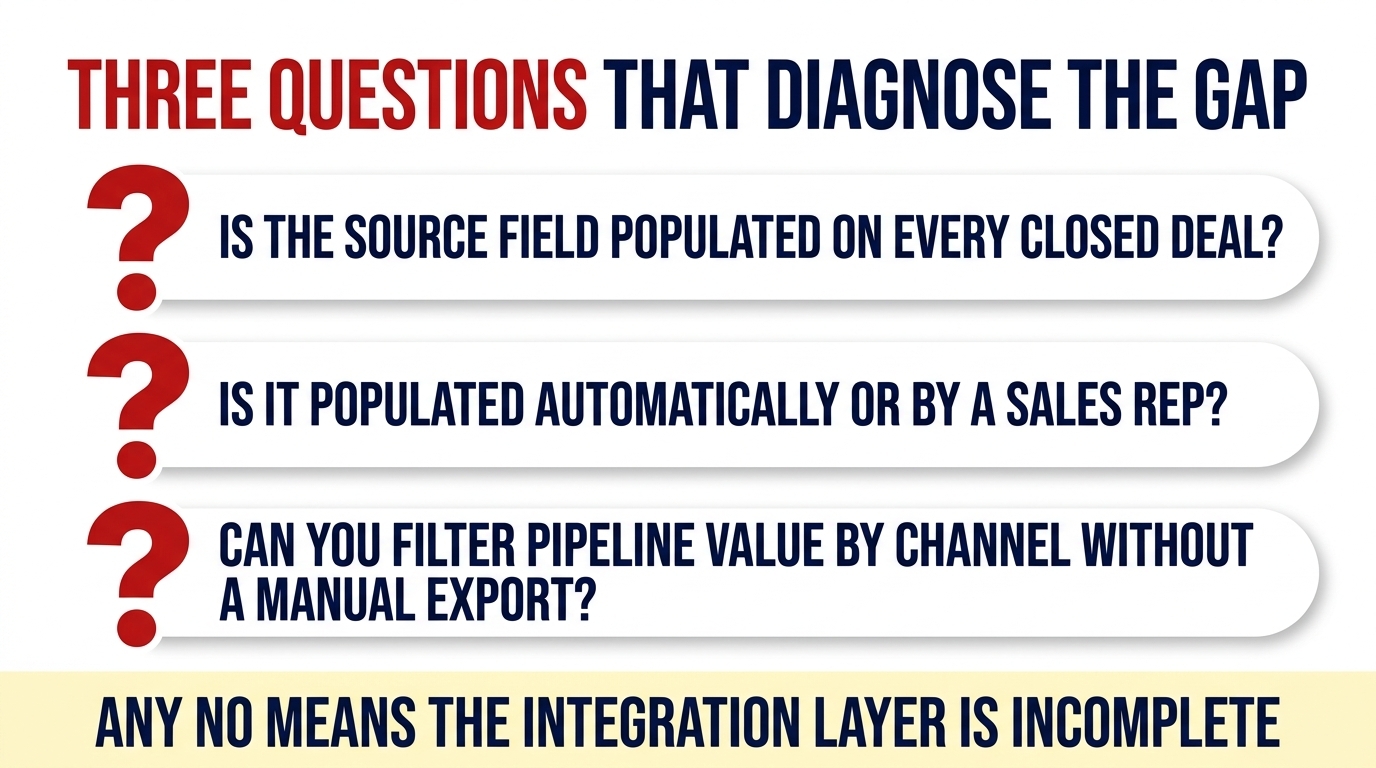
The diagnostic question is precise: can you trace every closed deal in your CRM back to its originating digital channel, including the first touch that began the sequence? If the answer is no for any significant proportion of closed deals, the problem is the integration layer, not the channel mix, the creative, or the budget level.
Three questions frame the diagnostic. First: Does every closed deal in the CRM have a source field populated with a specific digital channel? Second: Is that source field populated automatically by tracked UTMs and form capture, or manually by sales representatives? Third: Can you filter closed deals by source and see pipeline value by channel without a manual data exercise? If any answer is no, the integration layer is incomplete. This matters because the company with a configured attribution layer will consistently outperform a competitor spending more on unintegrated channels. The advantage is structural, not creative. Teams that have completed HubSpot CRM integration and configuration find that source fields populate automatically, removing manual data entry from the attribution process entirely. As market context rather than a Floodlight result: according to McKinsey (2021), personalisation most often drives a 10-15% revenue lift. Whether a team can see any of it in its own numbers depends on whether the source field is populated. Digital marketing measurement at this level is not a reporting improvement. It is the difference between budget decisions grounded in evidence and decisions made on incomplete data.
Frequently Asked Questions
What is digital marketing for a B2B Marketing Ops team?
For Marketing Ops, digital marketing is a connected source-to-revenue system rather than a list of channels. SEO, paid search, email, paid social and content each produce data, and that data only becomes attribution when it lands in the CRM against the right contact and survives through to the deal record. The channel work is the visible part; the configuration underneath it is what makes the channel work measurable.
How does digital marketing work once the CRM is properly configured?
Every channel is set up as a tracked source. A UTM structure is applied consistently, so the source field populates automatically at form submission rather than being typed in later. Scoring rules act on behaviour from those channels, routing rules assign qualified leads to a named representative, and the attribution model joins the first touch to the closed deal. Nothing in that chain depends on a person remembering to record something.
What are the main benefits of connecting digital channels to the CRM?
The practical benefits are that budget conversations stop being arguments about interpretation, that a channel can be defended or cut on evidence, and that nobody spends a day a month reconciling platform reports against the CRM by hand. The reasoning behind a routing decision is recorded rather than held in someone's head.
How long does it take to set up attribution for digital marketing?
It depends far more on the state of your existing data than on the tooling. A team whose CRM and marketing automation records already match, with lifecycle stages defined the same way in both systems, is configuring rules. A team whose records do not match is doing data work first, and that is the part that takes the time. What matters more than the duration is the order: source data cannot be recovered for contacts created before tracking was in place, so the configuration has to come before the spend.
Digital marketing vs traditional marketing: what is the key difference for Marketing Ops?
Traditional marketing produces impressions with limited traceability. Digital marketing produces a complete data trail from first touch to closed deal, but only if the tracking is built in before campaigns launch. The difference is not the channel or the format. It is that digital marketing can be measured at all, and that the measurement is a configuration decision rather than a reporting one.
Is a configured attribution layer worth it for a mid-market team running several channels?
It matters most when you are running several channels at once, because that is when platform reports start disagreeing with each other and with the CRM. If your team cannot filter closed deals by originating channel without a manual export, the attribution layer is the thing limiting your budget decisions, not the channel mix and not the creative.
Edwin works with UK B2B firms on connecting the CRM and marketing systems they already own, so that marketing spend can be traced to revenue without a manual data exercise.
Final word: build the data layer first
Define your attribution model, UTM structure, scoring rules, and routing logic in HubSpot or Pardot before any campaign spend begins. The teams that outperform on digital marketing do so because of configuration discipline, not channel selection.
Book a discovery call