

Responsible AI for Technology: Managing Risks and Impacts
Responsible AI implementation ensures technology companies deploy artificial intelligence ethically, transparently and accountably. It manages risks around bias, privacy and compliance while maximising business value. For technology teams, this means embedding governance frameworks from design through deployment, monitoring outcomes continuously and aligning AI systems with regulatory standards and organisational values.
For UK technology companies, responsible AI is a configuration discipline that reduces debugging time, strengthens product quality, and meets regulatory expectations head-on.
- Explainable outputs: Auditable AI decisions help engineering teams fix model errors faster, cutting support tickets.
- Human-in-the-loop oversight: Routine expert review catches edge cases automated checks miss, reducing customer-reported issues.
- Built-in governance: Aligning with UK and EU regulatory frameworks from design avoids costly retrofits later.
- Responsible lead scoring: Auditable, bias-checked models cut time wasted on miscategorised prospects, where poor data quality costs organisations at least $12.9 million a year (Gartner).
- Continuous monitoring: Tracking data drift prevents ungoverned models from silently degrading in production.
Introduction
For technology companies building and deploying AI products, responsible AI practices are not just a compliance overhead. They directly influence product reliability, customer confidence, and operational efficiency. In the UK, where regulatory expectations are sharpening, getting this right early prevents costly redesign and reputational damage.
The following sections lay out the practical steps to embed these practices into your AI development and deployment, from governance frameworks to day-to-day monitoring.
What does responsible AI implementation actually mean for UK technology companies?
Responsible AI implementation, for a UK technology company, means building governance into the product development cycle itself through model documentation, accountability mapping, and scheduled output reviews. It is an engineering and commercial discipline: the decisions made during model selection, training data sourcing, and deployment configuration determine product reliability, buyer confidence, and long-term support costs.
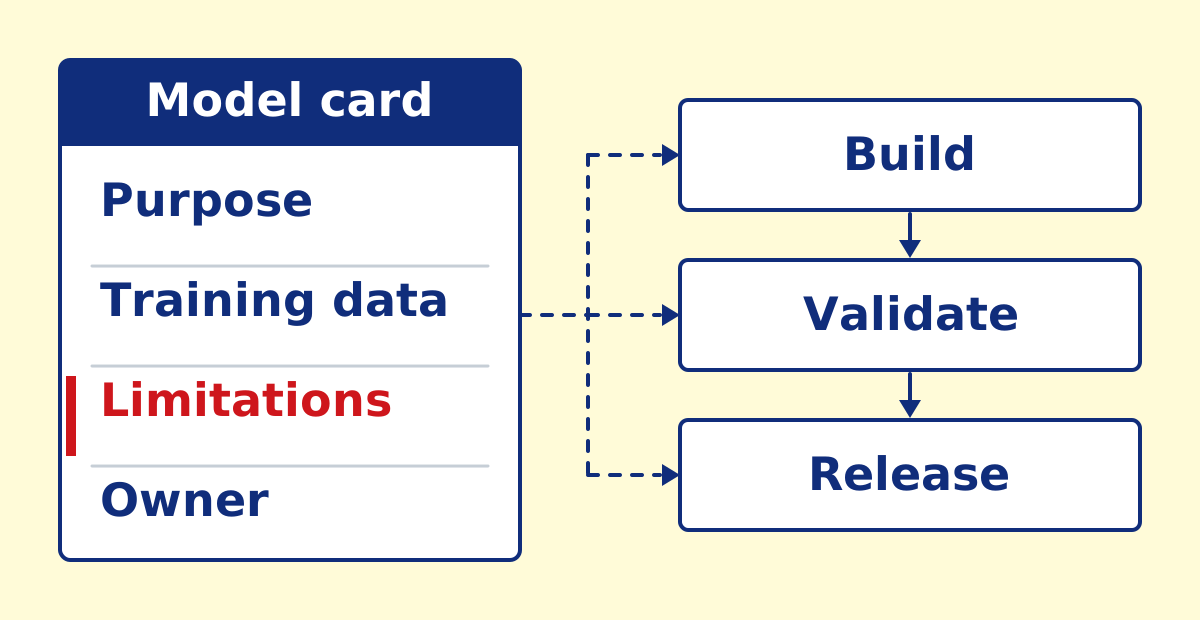
At the product level, responsible AI looks like model cards that record what a model does, what data it was trained on, and where its limitations lie. It means risk classification, which categorises models by their potential impact so that oversight effort stays proportional, and regular review cadences that catch performance changes before they reach customers. UK regulatory expectations are principles-based rather than prescriptive, which means technology teams cannot rely on a compliance checklist to define adequate governance; they must define their own standards. That design responsibility sits with engineering and product leads, not legal teams. Floodlight works with UK technology businesses to embed this kind of governance directly into AI-driven marketing and qualification systems, treating it as a configuration discipline from day one.
|
58%
of executives say responsible-AI initiatives improve ROI and efficiency (PwC)
|
40%
of enterprise applications will include task-specific AI agents by 2026 (Gartner)
|
800m
weekly active ChatGPT users in 2025, roughly one in ten adults worldwide (Fortune)
|
Why is ungoverned AI a hidden cost rather than just a compliance risk?
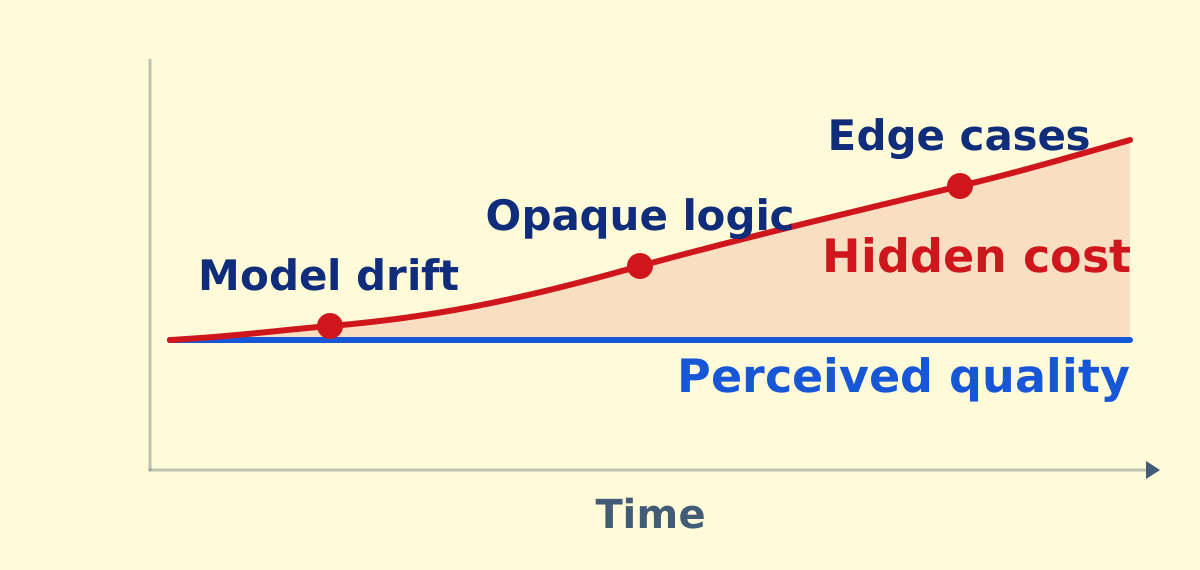
Ungoverned AI models consume time through technical debt, gradually through longer debugging cycles, rising support ticket volumes, and degraded outputs that erode product quality before any single incident triggers a formal review. Because the deterioration is incremental, it rarely appears in post-deployment reviews, yet the operational cost compounds steadily over time.
Three mechanisms drive this accumulation. First, silent model drift: as production data shifts away from the distribution the model was trained on, output quality degrades without triggering automated alerts, because no threshold has been defined to detect the change. Second, opaque decision logic creates a debugging bottleneck. When a model's reasoning cannot be inspected, engineering teams must run broad diagnostics across inputs, features and infrastructure rather than isolating the specific condition that caused an error. Third, as edge cases multiply in production, customer support ticket volumes rise, particularly for B2B software where AI outputs feed directly into customer workflows. A contract analysis tool that misclassifies a clause, or a prioritisation model that surfaces the wrong records, creates downstream disruption for the buyer's own team, compounding the support burden on both sides.
What does a practical AI governance framework look like for a technology business?
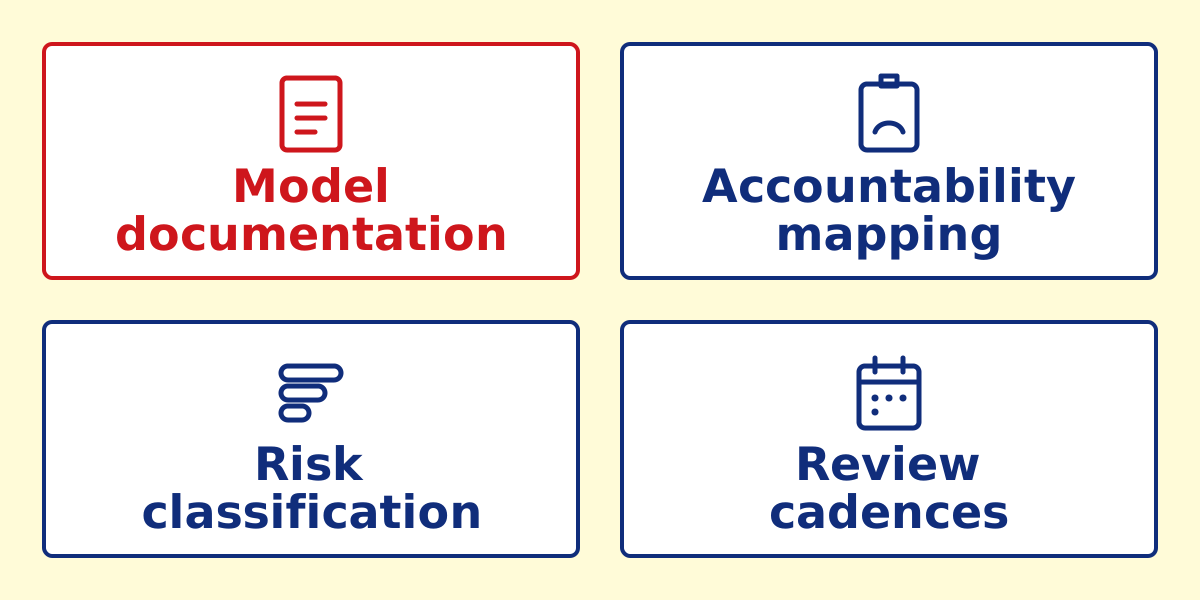
A practical AI governance framework for a technology business is a working structure built around four components:
- Model documentation
- Accountability mapping
- Risk classification
- Scheduled review cadences
It is designed for engineering and product teams to run as part of normal delivery cycles, not as a separate compliance programme maintained by a legal or risk function.
Model documentation records what each model does, the provenance of its training data and its known limitations. That record forms the foundation for debugging, audit and buyer review. Accountability mapping assigns named owners to model performance and incident response, so that when a model behaves unexpectedly in production, there is a defined person or team responsible for investigation and remediation. Risk classification categorises models by potential impact level, allowing teams to concentrate oversight effort where output errors carry the greatest commercial or operational consequence. For teams operating AI automation for technology companies, governance structures apply equally to lead qualification or marketing automation systems as to customer-facing product models. Review cadences scheduled at defined intervals rather than triggered only by incidents create the checkpoints that catch slow-moving performance changes before they become customer-reported problems.
How does the NIST AI Risk Management Framework apply in a UK context?
The NIST AI Risk Management Framework names four functions:- Govern,
- Map,
- Measure
- Manage
Govern sets the accountability mapping: who owns the tool's performance, and who is called when it misreads a clause.
Map sets the risk classification: which clause types cost the customer most when the tool gets them wrong.
Measure sets the evidence in the model documentation: precision and recall on those clause types, bias audit results, and the drift threshold that fires an alert.
Manage sets the response when that alert fires: who investigates, what is remediated, and when the next review falls.
NIST and UK guidance are different kinds of document, not competing positions. NIST is voluntary and detailed. Guidance from bodies such as the ICO and the Alan Turing Institute states principles and leaves the method to each organisation. So a UK team can adopt the four functions as a working structure without being required to: they supply the operational detail that guidance deliberately leaves open.
How do UK regulatory expectations differ from the EU AI Act?
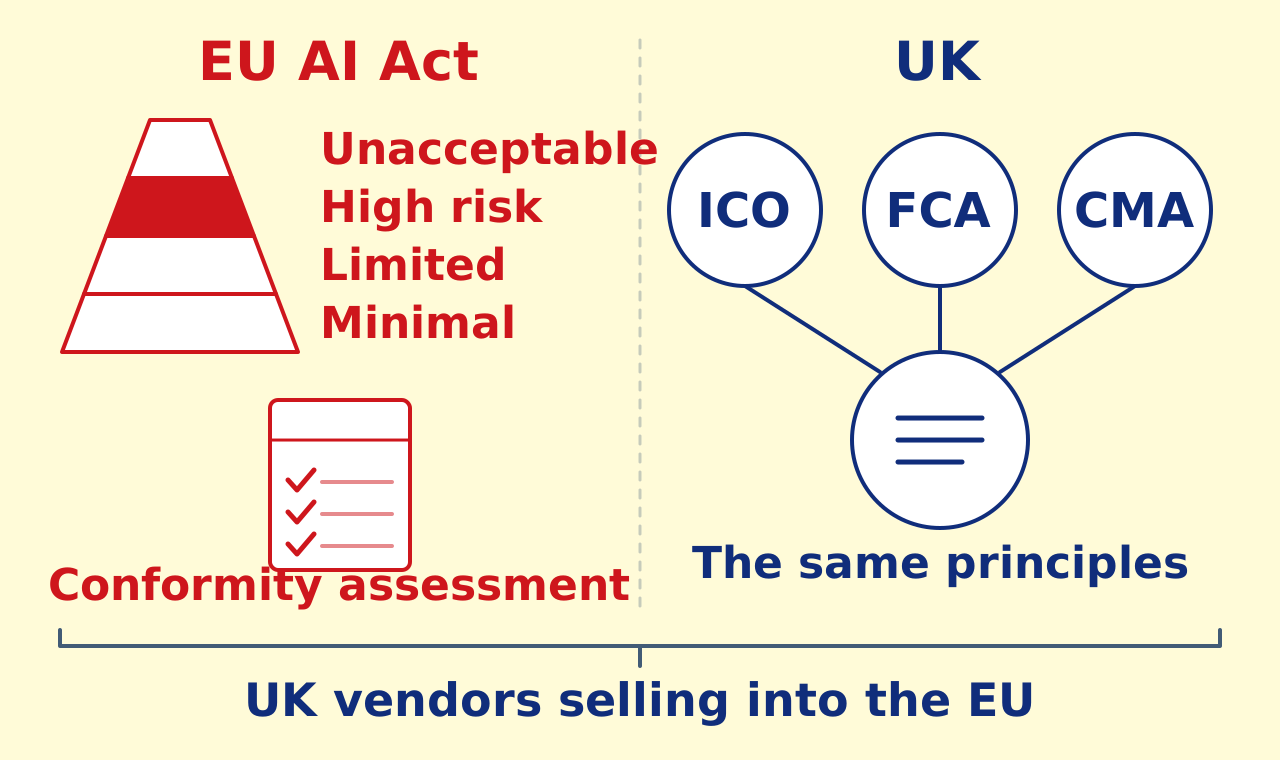
The EU AI Act imposes a risk-tiered, prescriptive compliance structure. AI systems classified as high-risk, including those used in recruitment, credit assessment and certain business-critical decision-making, must meet specific technical documentation, conformity assessment and human oversight requirements before they can be placed on the EU market. Obligations are detailed, externally verifiable, and carry significant penalties for non-compliance.
UK regulatory expectations, by contrast, remain principles-based and sector-led. There is no single AI Act equivalent in UK law. Instead, existing regulators (the ICO, FCA, CMA and others) apply AI-relevant principles within their existing sectoral remits. This approach gives technology teams more design flexibility but also more interpretive responsibility: there is no prescribed conformity checklist to satisfy.
For UK technology companies selling into EU markets, both regimes apply simultaneously. A B2B SaaS product used by EU customers in a high-risk AI Act category carries the full weight of EU Act compliance obligations, regardless of where the vendor is incorporated. Technology teams should map their product against the EU Act's high-risk provisions early in the development cycle, since retrofit compliance is substantially more costly than building to the standard from the outset.
Treating responsible AI as a documentation exercise rather than an operational discipline
What happens: Technology companies produce ethics policies but skip continuous monitoring, so models drift and bias accumulates undetected. Support costs rise as silent degradation compounds.
What to do instead: Assign clear ownership for ongoing AI audits and tie model performance reviews to a regular, calendar-scheduled governance cadence. Embed monitoring thresholds from deployment so that drift triggers alerts, not just retrospective reports.
Not sure your AI governance would survive a buyer's review?
Book a 30-minute call and we will walk your current models, data flows and oversight steps against what UK regulators and enterprise buyers now ask for. You leave with a prioritised list of the highest-risk gaps, whether or not you work with us.
Book a 30-minute callHow does explainable AI reduce debugging time and support costs?
Clear auditable and readable AI outputs shorten the feedback loop between error occurrence and engineering fix, which directly reduces support ticket volume for B2B AI products. Concise explanations is an efficiency tool: when model outputs include decision traces or confidence scores, engineers can isolate the specific input conditions that caused an error rather than running broad diagnostics across an entire system.
Tools such as SHAP (SHapley Additive exPlanations) and LIME (Local Interpretable Model-agnostic Explanations) surface the feature contributions driving individual model outputs. When a model returns an unexpected result, the engineering team can inspect which input variables carried the most weight in that decision, identifying whether the issue stems from a specific data condition, a feature interaction or a distribution shift in production data. This precision reduces mean time to resolution for model-related support tickets, because the diagnostic surface is narrowed before investigation begins. In B2B sales cycles, explainability documentation also supports buyer confidence: procurement teams assessing an AI product can review decision logic at the output level rather than relying on vendor assurances. Connecting explainable model outputs to a CRM integration creates a natural audit trail for lead scoring decisions, giving both the selling team and the buyer a traceable record of how qualification decisions were reached. Floodlight builds auditable outputs into AI-driven qualification workflows as a standard configuration step, treating decision traceability as an operational requirement rather than an optional feature.
How does human-in-the-loop oversight improve AI product quality in production?
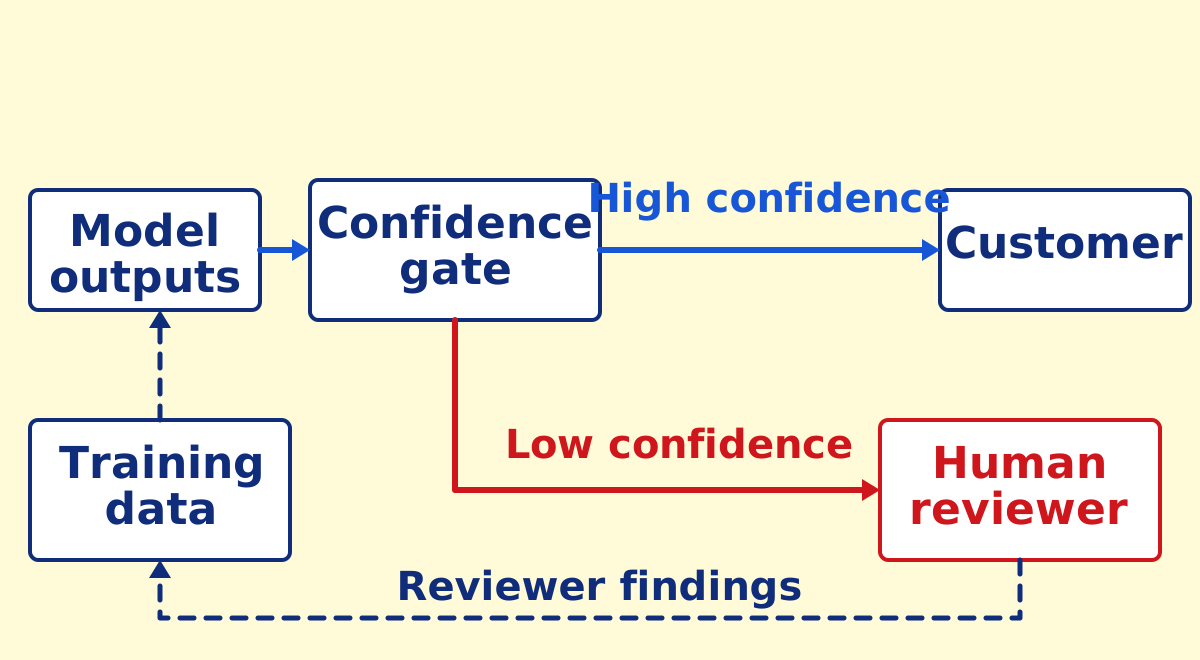
Human-in-the-loop oversight works by routing flagged or low-confidence AI outputs to qualified reviewers before they reach end users or downstream systems. This catches the edge cases that automated checks miss, particularly outputs falling outside the model's training distribution, and it materially reduces customer-reported errors in B2B AI products.
The operational design has three components:
- Flagging Criteria: outputs below a defined confidence threshold, or those generated from input data that sits outside the training distribution, are held for review rather than passed through automatically.
- Reviewer Qualification matters. Domain experts or a dedicated QA function should review flagged outputs, not generalist staff, because accurate resolution requires the subject-matter knowledge to judge whether the output is genuinely erroneous or an acceptable edge case.
- Reviewer Findings feed back into the model itself: confirmed errors update retraining datasets or trigger rule-based corrections, so the model's coverage of edge cases improves over time rather than generating a persistent stream of manual interventions.
Consider a contract classification tool used by a B2B legal technology product: without human-in-the-loop review, an atypical clause structure could be misclassified and passed downstream into the customer's workflow, causing document processing errors that the customer attributes to product failure. Routing low-confidence classifications to a reviewer prevents that failure mode and preserves the product's reliability reputation. That is the kind of compounding support-cost reduction responsible AI implementation delivers beyond its compliance function.
How can technology companies identify and mitigate algorithmic bias before deployment?
Algorithmic bias can be identified before deployment through disaggregated performance testing, which evaluates model accuracy separately across different data subgroups. This is achievable for technology teams without a dedicated AI ethics function, using standard validation tooling already present in most engineering workflows.
Three practical methods cover the core of pre-deployment bias identification.
1. Disaggregated performance testing: Split the validation dataset by relevant subgroups and compare accuracy metrics across them. For B2B models that usually means industry vertical, company size band and geography. A lead scoring model that looks strong on average can still underperform badly for specific sectors or size bands, and that skews qualification outcomes in ways that hit both commercial results and buyer trust.
2. Fairness metrics: Measures such as demographic parity or equalised odds put a number on the gap between subgroups. That turns a qualitative worry into something you can size, track and act on.
3. Data provenance review: Audit the training data for historical skew. If it came from a sample that does not represent the target population, that skew is encoded in the model's behaviour however sound the architecture is.
Floodlight treats bias auditing as a standard configuration and QA step when building lead scoring models, reviewing subgroup performance before deployment rather than after customer-reported discrepancies surface the problem.
How does continuous model monitoring prevent silent degradation in production?
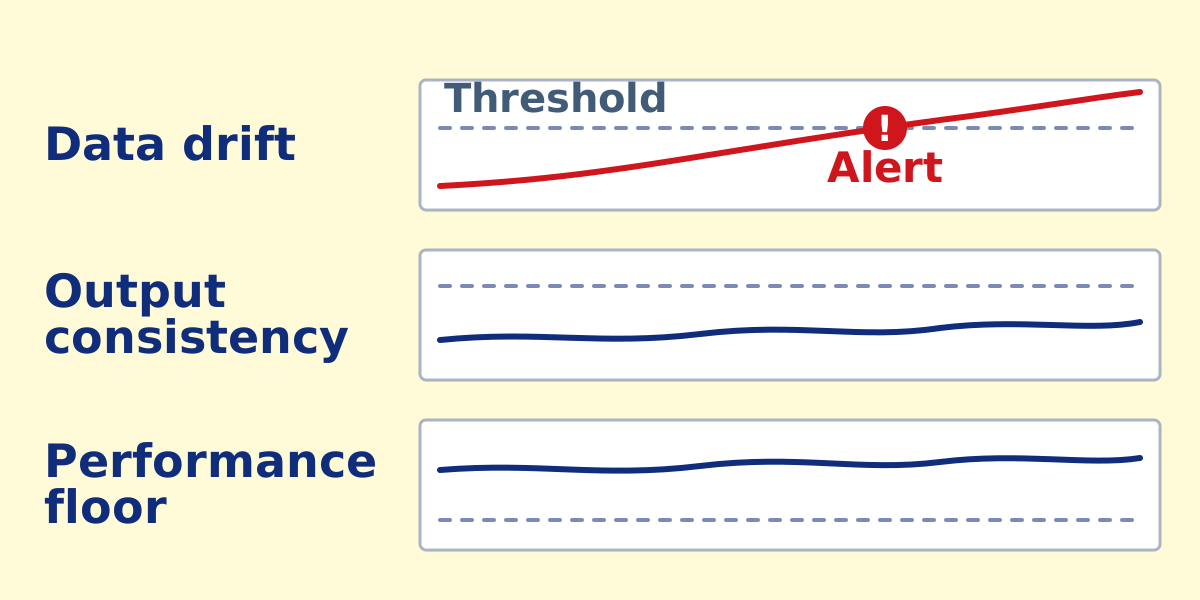
Continuous monitoring, which tracks data drift, output consistency and model performance against defined thresholds, prevents AI models from degrading silently in production. Alerts trigger review only when thresholds are breached, preserving product reliability without requiring constant manual intervention from the engineering team.
Three monitoring practices form the operational core. Data drift detection compares the statistical distribution of incoming production data against the training data distribution; when the gap crosses a defined threshold, it signals that the model is operating outside the conditions it was built for, and that output quality may have deteriorated even if no customer has yet reported a problem. Output consistency tracking monitors whether model outputs remain within expected ranges over time: whether a classification model's confidence-score distribution is shifting, for instance, or whether a prioritisation model is concentrating its outputs in ways that suggest a feature-weighting problem.
Alert thresholds set performance floor values (precision, recall, or business-relevant metrics such as qualification accuracy) that trigger automated notifications to the engineering team when breached. For marketing automation for technology companies running AI-driven qualification in production, these monitoring practices apply directly: a model scoring inbound leads that drifts without detection will systematically misroute prospects, compounding both sales inefficiency and support overhead over time. Ungoverned models accumulate this hidden technical debt quietly, and the longer it goes undetected the more expensive the remediation.
How does responsible AI implementation affect procurement and B2B sales cycles?
Technology buyers increasingly include AI transparency, documentation, and governance evidence in their vendor assessment criteria. Responsible AI implementation increasingly shapes how quickly a B2B AI product clears procurement review. Teams with documentation prepared in advance move through those reviews faster and signal a level of product maturity that underprepared competitors cannot match.
Procurement teams now routinely request model cards, bias audit summaries, data provenance documentation, and human oversight policies as part of vendor evaluation. This scrutiny is intensifying for two reasons. The EU AI Act creates downstream compliance obligations for enterprise buyers of AI products. A buyer subject to the Act's high-risk provisions needs confidence that its vendors' systems will not create a compliance gap in its own stack. Separately, large enterprise buyers are developing internal AI governance policies that require evidence of responsible practices from software suppliers, independent of regulatory mandates. Having governance documentation prepared before the procurement process begins shortens the review cycle. It removes the back-and-forth that commonly extends AI product evaluations, and it positions the vendor as a mature, trustworthy supplier rather than one whose practices are opaque. Floodlight supports technology clients in preparing AI governance documentation as part of B2B go-to-market preparation, treating this collateral as a commercial asset with direct bearing on procurement outcomes rather than a compliance burden assembled after the fact.
Conclusion
Responsible AI governance is not a compliance exercise bolted on after deployment. It is a configuration discipline that determines product reliability, procurement outcomes and long-term support costs from the first line of model documentation. For UK technology companies, the organisations that build governance structures into their development cycles early will move through buyer scrutiny faster, accumulate less technical debt in production, and maintain output quality as production data shifts over time. Floodlight's AI-driven qualification systems are built with auditable outputs and human-in-the-loop review as standard. This is the kind of governance discipline that pays back, with 58% of executives saying responsible-AI initiatives improve ROI and efficiency (PwC).
If you are ready to apply these principles to your own AI-driven marketing or qualification systems, book a 30-minute call to scope your AI governance setup.
Frequently Asked Questions
What is responsible AI for technology teams?
Responsible AI for technology teams means building governance into how AI products are designed, trained and deployed. It covers model documentation, bias checks, human oversight and continuous monitoring, so that outputs stay accurate, explainable and accountable. The aim is dependable products that meet regulatory expectations while protecting customer trust and engineering time.
How does responsible AI work in practice?
Responsible AI works by embedding checks at each stage of the model lifecycle. Teams document what a model does, classify its risk, route low-confidence outputs to human reviewers, and monitor production data for drift. When a defined threshold is breached, an alert triggers review, so problems surface before customers report them.
What are the benefits of responsible AI for a technology business?
The benefits of responsible AI include shorter debugging cycles, fewer support tickets, and steadier product quality as data shifts. Explainable outputs help engineers isolate errors quickly, while documented governance reassures buyers during procurement. Over time this reduces hidden technical debt and shortens sales cycles, turning governance into a commercial advantage rather than overhead.
How much does responsible AI cost in time and money?
Responsible AI need not add heavy cost or time. Most checks, from disaggregated testing to drift monitoring and review cadences, use tooling already present in engineering workflows. The larger expense is retrofitting governance after deployment, which is far more costly than building it in from the first line of model documentation. Budget for setup, not constant firefighting.
How does responsible AI compare with unmanaged AI?
Responsible AI differs from unmanaged AI in visibility and control. Unmanaged models drift silently, accumulate bias, and raise support costs before anyone notices. Responsible AI makes outputs explainable, assigns clear ownership, and sets monitoring thresholds that flag problems early. The upfront effort is higher, but the running cost and reputational risk are far lower.
Who is responsible AI most suited to?
Responsible AI suits any technology company shipping AI features into products or internal workflows, particularly B2B software vendors whose outputs feed customer processes. It matters most where errors carry commercial or regulatory weight, such as contract analysis, lead scoring, or credit decisions. Teams selling into EU markets have the strongest reason to adopt it.
What is the most common mistake with responsible AI?
The most common mistake with responsible AI is treating it as a documentation exercise rather than an operational discipline. Teams write ethics policies but skip continuous monitoring, so models drift and bias builds up undetected. Assign clear ownership, schedule regular reviews, and set monitoring thresholds from deployment so drift triggers alerts, not retrospectives.
What is the one metric to track for responsible AI?
The single metric to track for responsible AI is data drift: the gap between production data and the distribution a model was trained on. When drift crosses a defined threshold, output quality is likely deteriorating even without complaints. Watching it gives early warning, letting teams act before customers feel the impact.
Find out where your AI governance actually stands
For UK technology companies, building governance structures into development cycles early reduces technical debt, speeds procurement, and maintains output quality. Pilot auditable, human-in-the-loop review in your lead scoring for 30 days, and record what it changes about your review time and error rate. The AI Enhancement Audit is a £997 fixed-price review of your AI and CRM setup. We map your models, data flows and access boundaries against UK GDPR, the Data (Use and Access) Act and ICO guidance on automated decisions, then hand you a prioritised list of the gaps that carry the most commercial and compliance weight. You keep the findings whether or not you work with us.
Book a discovery call