

A headless CMS improves SEO by separating content management from presentation, letting MarTech teams deliver structured, API-first content across channels without template constraints. Developers gain precise control over page speed, schema markup and metadata while editors work in a single repository producing cleaner technical foundations that search engines consistently reward.
A headless CMS improves technical SEO performance, but the real risk for MarTech teams is governance losing editorial control over the fields and workflows that keep organic visibility intact.
- Speed isn't the whole story: Server-side rendering and static generation improve Core Web Vitals, but SEO governance often gets harder, not easier, once the build is live.
- The 30-second task that becomes a ticket: Canonical fixes and 301 redirects that editors once handled directly can end up queued in a developer backlog, slowing routine SEO maintenance.
- Build controls into the content model: Meta fields, redirect management and structured data must be first-class fields at architecture stage, not retrofitted after launch.
- Migration is where drift starts: Moving from a traditional CMS without mapping existing SEO workflows is where most mid-market teams lose visibility, sometimes silently, for months.
- Structured integration saves time: Configuring CMS-to-CRM integrations with SEO data flows mapped removes manual handoffs between marketing and engineering, reclaiming marketer time each week. In HubSpot State of Marketing research, about a third of marketers say AI saves their team 10-14 hours per week.
Introduction
Headless CMS adoption among MarTech teams has accelerated steadily, and the commercial case is well established: faster front-end performance, cleaner API integrations, and a content model that isn't tied to a single presentation layer. What the vendor documentation rarely addresses is what happens to SEO governance once the build is live. For teams evaluating headless CMS for SEO, the performance gains are real but so are the operational gaps that open up the moment editorial control moves further from the content itself.
The conventional argument for headless CMS leans heavily on Core Web Vitals and page speed. Both improve with server-side rendering and static site generation, and neither is in dispute here. The problem is that speed scores don't capture what happens when an editor who once updated a canonical tag or published a 301 redirect directly in WordPress now needs to raise a developer ticket to do the same task. In 2026, with organic visibility increasingly tied to structured data accuracy and crawl efficiency, that delay compounds quickly and mid-market MarTech teams are the ones most exposed, because they rarely have the engineering resource to absorb the overhead.
Floodlight works with UK B2B companies to configure CMS and CRM integrations so that SEO controls sit where marketers can reach them, not buried in a backlog. That structured approach to removing manual handoffs between teams is how we free marketers from repetitive coordination work. This guide covers the technical and governance decisions that determine whether a headless CMS strengthens or quietly undermines your organic performance.
Is headless CMS actually good for SEO?
Headless CMS genuinely improves technical SEO performance through faster rendering and cleaner architecture but governance gaps, not speed scores, are the primary risk for mid-market MarTech teams. The performance gains are measurable and well documented. The operational risks are less visible and more damaging over time.
Where headless CMS genuinely improves SEO performance
Static site generation pre-renders pages at build time, eliminating server response latency. Server-side rendering delivers fully rendered HTML to crawlers, improving indexation reliability. CDN delivery reduces time-to-first-byte. These gains are measurable and apply directly to Core Web Vitals pass rates. According to Statista (2024), headless CMS adoption has grown substantially among enterprise and mid-market teams, with composable architectures now representing a majority of new enterprise CMS implementations.
The SEO risk speed scores will not show
The governance gap is the underreported risk for teams this size. When canonical tags, redirect rules, and structured data schemas no longer sit in a CMS field an editor can reach, they move into a development pipeline. For mid-market MarTech teams without embedded engineering resource, SEO maintenance slows or stalls as a result. When a headless CMS is compared against a traditional CMS for SEO, this is the gap that rarely features in vendor documentation and organic performance can drift for months before analytics surfaces the cause.
Headless CMS and Core Web Vitals
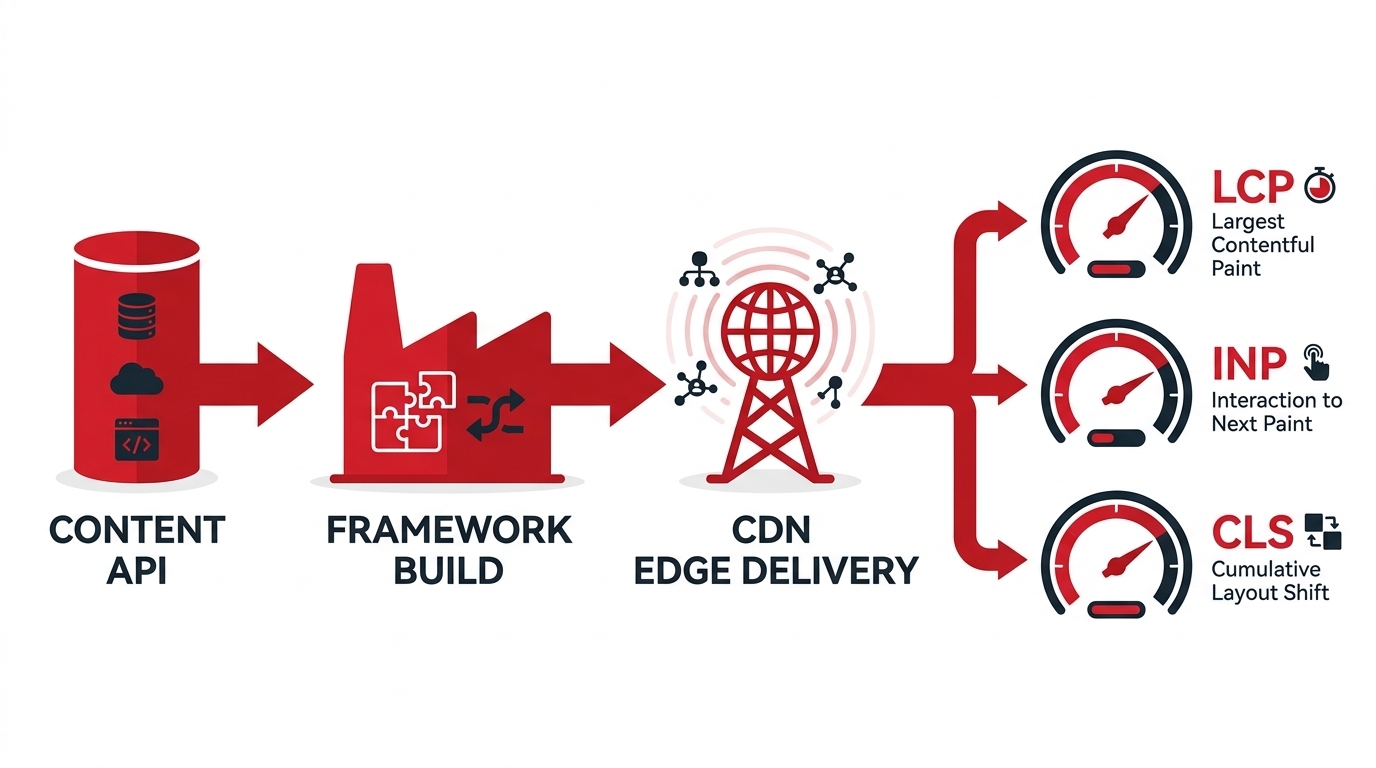
Headless builds using SSR or SSG serve pre-rendered or server-rendered HTML, reducing render-blocking JavaScript and improving Largest Contentful Paint (LCP) and Time to First Byte (TTFB). For B2B MarTech sites with complex landing page stacks, these are meaningful, measurable gains not theoretical ones.
The SSR versus SSG trade-off has practical implications for SEO specifically. SSG is faster at delivery but requires rebuild cycles for content updates a relevant constraint for teams publishing frequently. SSR maintains real-time content accuracy at a slight performance cost. Beyond rendering method, API-first CMS architecture improves crawl efficiency: fewer render-blocking scripts mean Googlebot can index more pages per crawl budget. According to Google Search Central and HTTP Archive data (2024), server-side rendered pages show materially higher Core Web Vitals pass rates than equivalent client-side rendered pages, with LCP in particular improving significantly when render-blocking JavaScript is removed from the critical path. Performance configuration decisions affect both user experience and crawl efficiency, and the two interact more closely than most vendor comparisons suggest. The point is not that performance gains are absent, but that confirming they exist is the prerequisite for the governance critique that follows.
Why SEO governance gets harder after launch
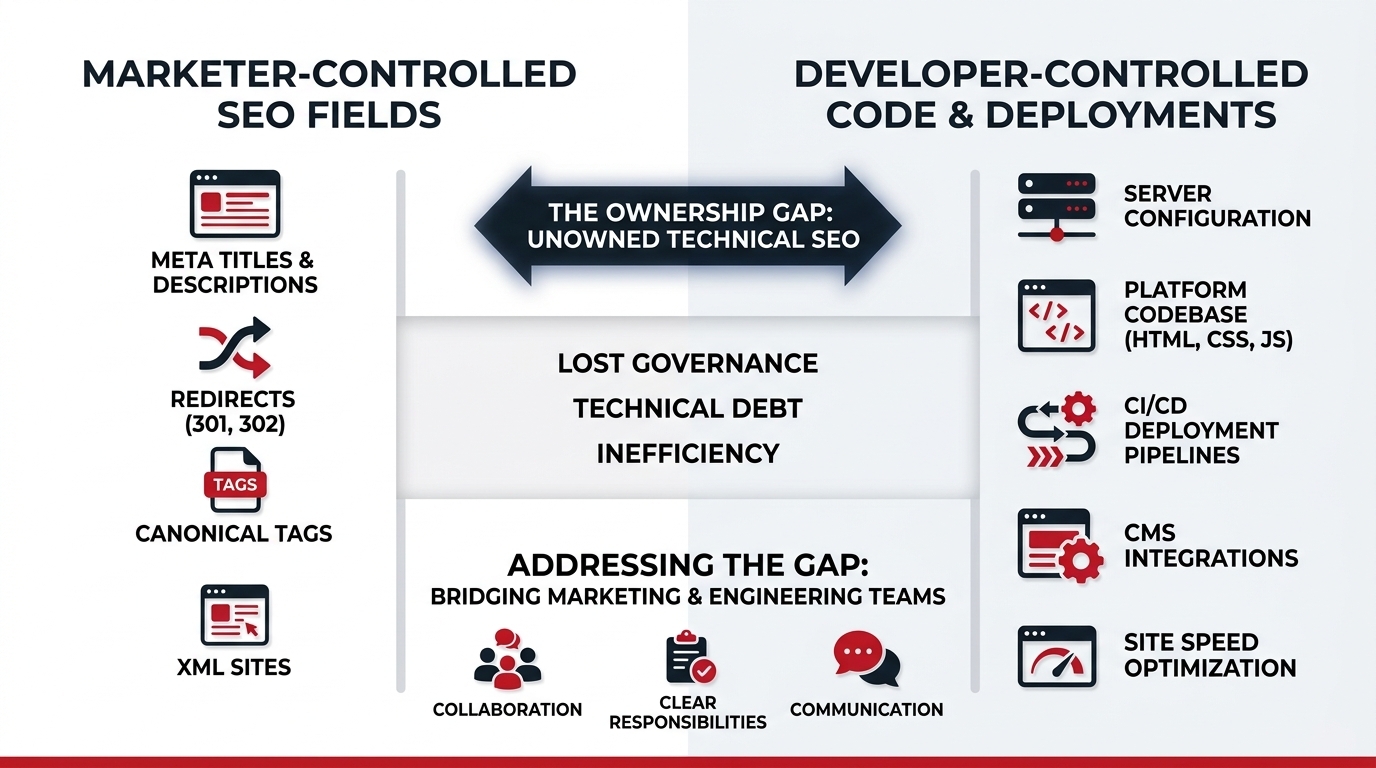
SEO governance degrades in headless builds because the editorial workflows that previously kept SEO maintained canonical updates, redirect additions, meta field edits were designed around CMS-native controls that no longer exist in a headless architecture. For MarTech teams with lean engineering resource, this creates a structural accountability problem from day one.
The 30-second task that becomes a developer ticket
Consider a concrete scenario: an editor identifies a duplicate content issue requiring a canonical tag update. In WordPress, this is a field edit. In a headless build without configured editorial controls, it becomes a ticket raised to a developer, queued against sprint priorities, reviewed, and deployed. For a company of 20 to 100 people, that realistically means days to weeks of delay. Across redirect management, meta field updates, and structured data corrections over a quarter, the compounding effect on organic performance is significant and largely invisible until a ranking drop surfaces in analytics.
How SEO responsibility fragments across teams
API-first CMS models distribute SEO ownership across front-end developers (structured data implementation), DevOps (redirect rules), and marketing (meta content) with no shared interface and no clear escalation path. According to Ahrefs (2023), a significant proportion of SEO issues on mid-market sites are attributable to implementation or workflow gaps rather than technical errors, pointing to process and ownership failures rather than code.
The outcome is that when a ranking drop surfaces in analytics, the root cause is often a redirect that was never implemented or a canonical tag that was never updated during a URL restructure with no single team having noticed, because no single team owned it. Addressing SEO governance in a headless CMS requires ownership to be mapped at integration design stage; Floodlight's configuration work does this explicitly, assigning SEO controls to the teams responsible for them before go-live rather than after.
Building SEO controls into the content model
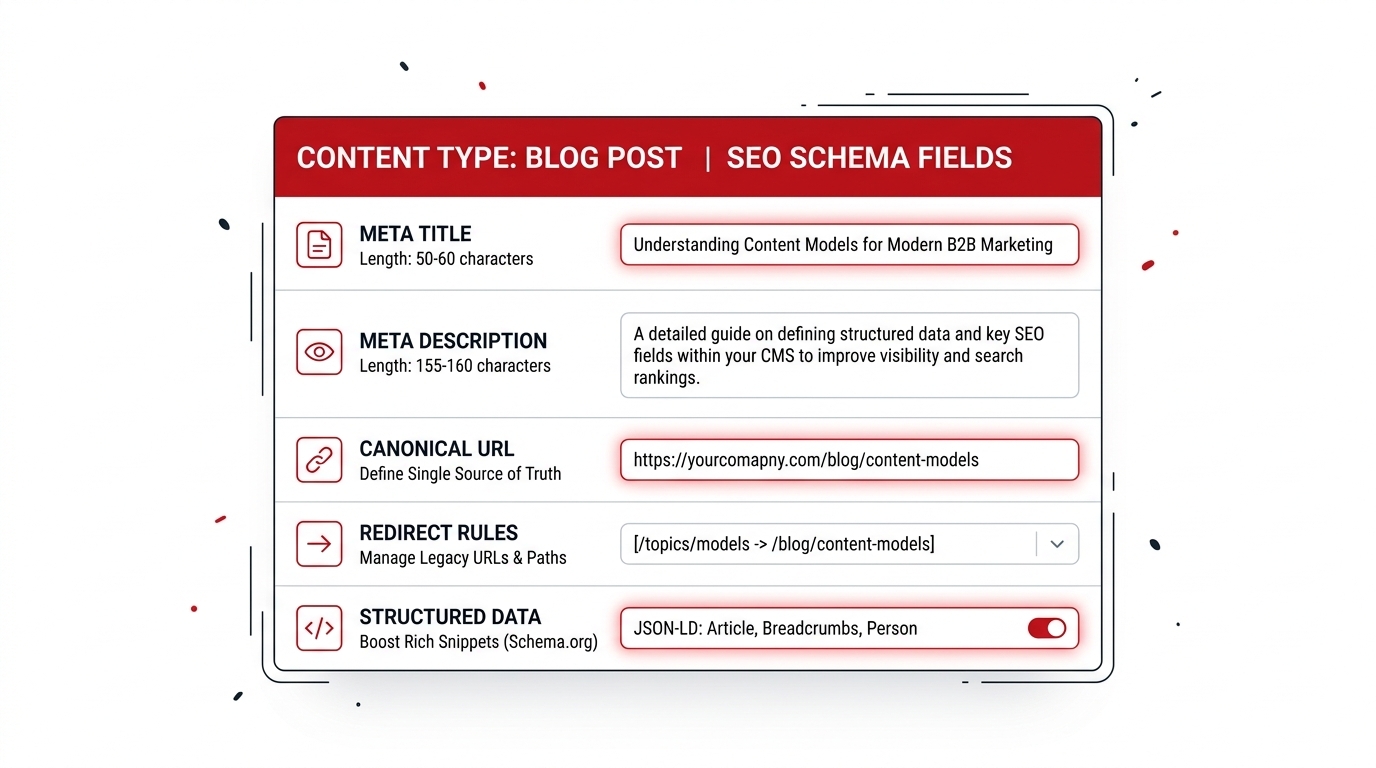
The single most important SEO decision in a headless build is not which rendering method to use it is whether SEO-critical fields are built into the content model at architecture stage, before launch. Teams that plan this up front retain editorial control; those that retrofit it post-launch face months of catch-up.
Three content modelling decisions determine the outcome:
- Meta fields: Title, description, canonical URL, and robots directives must be first-class fields in the content model, mapped to every content type before build begins not added as afterthoughts.
- Redirect management: A marketer-accessible redirect layer, whether CMS-native or a middleware integration, must be configured before migration, not raised as a post-launch ticket.
- Structured data schemas: JSON-LD should be generated from content model fields rather than hard-coded in front-end templates, so editors control the data that populates it without requiring a deployment cycle.
Marketer time is reclaimed when SEO controls are configured into the content model and manual handoffs between marketing and engineering teams are removed. These three decisions form the practical architecture checklist to take into any vendor or developer conversation about content modelling for SEO and structured data in a headless CMS.
Planning a headless CMS build or migration?
Floodlight helps MarTech teams design SEO governance, redirects, and CRM integrations into a headless stack before go-live, not after organic traffic slips. Book a call to pressure-test your content model against real organic risk.
Book a discovery callMigrating without losing organic visibility
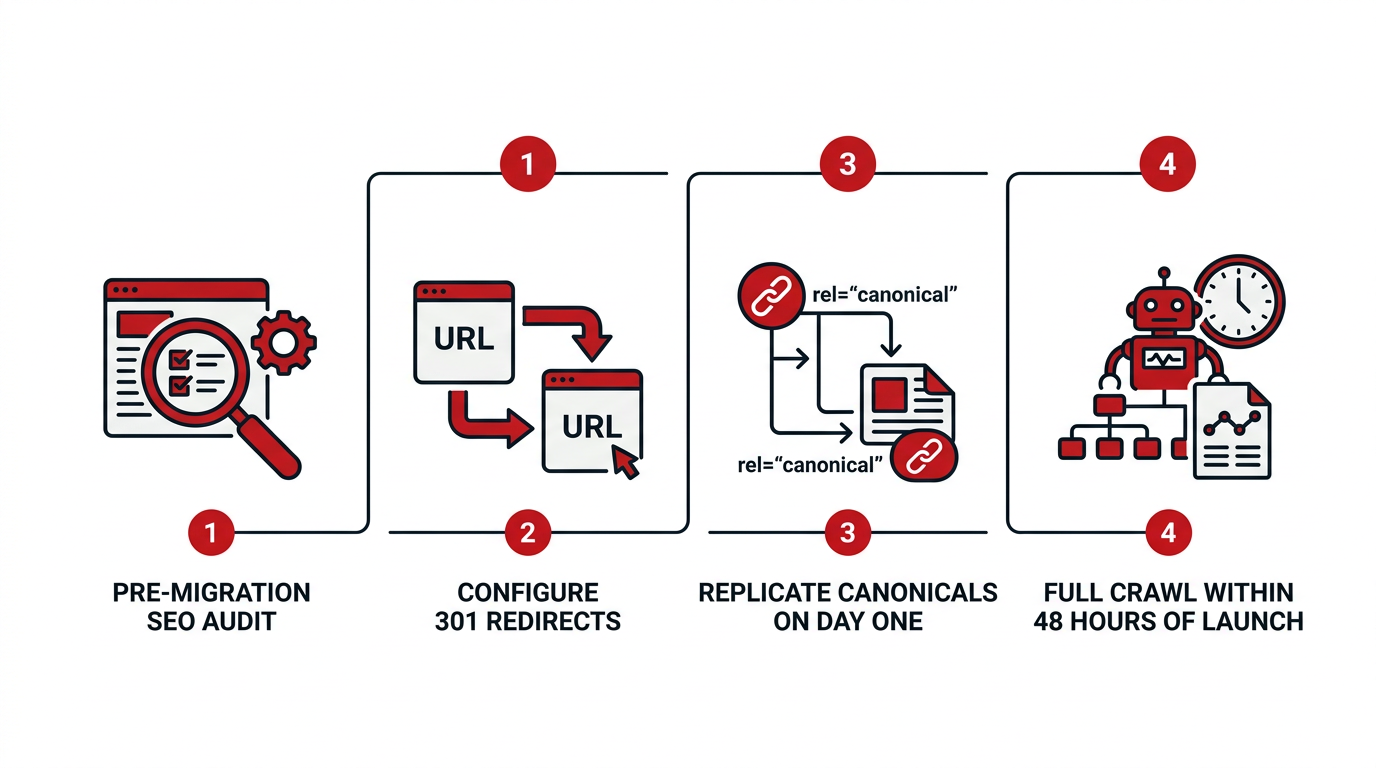
Organic visibility loss during CMS migration is not inevitable, but it is the default outcome when SEO workflows are not mapped before the migration begins. Teams that avoid ranking loss treat redirect mapping, canonical continuity, and structured data carry-over as migration deliverables not post-launch clean-up tasks.
Four planning steps prevent silent ranking loss:
- Pre-migration SEO audit: A full URL inventory, identification of pages with link equity, canonical chains, and structured data schemas in use. A headless CMS SEO migration that skips this step has no reliable baseline.
- Redirect mapping: Every URL that changes requires a 301 redirect configured before go-live, not after.
- Canonical continuity: Self-referencing canonicals must be replicated in the new content model fields on day one.
- Post-launch crawl monitoring: Screaming Frog or an equivalent tool should run within 48 hours of go-live to catch redirect loops, missing canonicals, and indexation anomalies before they compound.
According to Semrush (2023), a significant percentage of sites experience measurable organic traffic decline following CMS migration, with redirect errors and canonical misconfigurations among the most common causes. Mid-market B2B MarTech teams that migrate CMS while simultaneously redesigning site architecture double this risk; each change must be tracked independently.
Migrating and redesigning at the same time
What happens: Combining a CMS migration with a site redesign doubles the risk of organic traffic decline. Redirect errors and canonical misconfigurations go unnoticed because two sets of changes are entangled, and rankings can drift for months before analytics isolates the cause.
What to do instead: Track each change independently. Complete the pre-migration SEO audit first, configure every 301 redirect before go-live, replicate canonicals on day one, and run a full crawl within 48 hours of launch.
Connecting headless CMS to your CRM safely
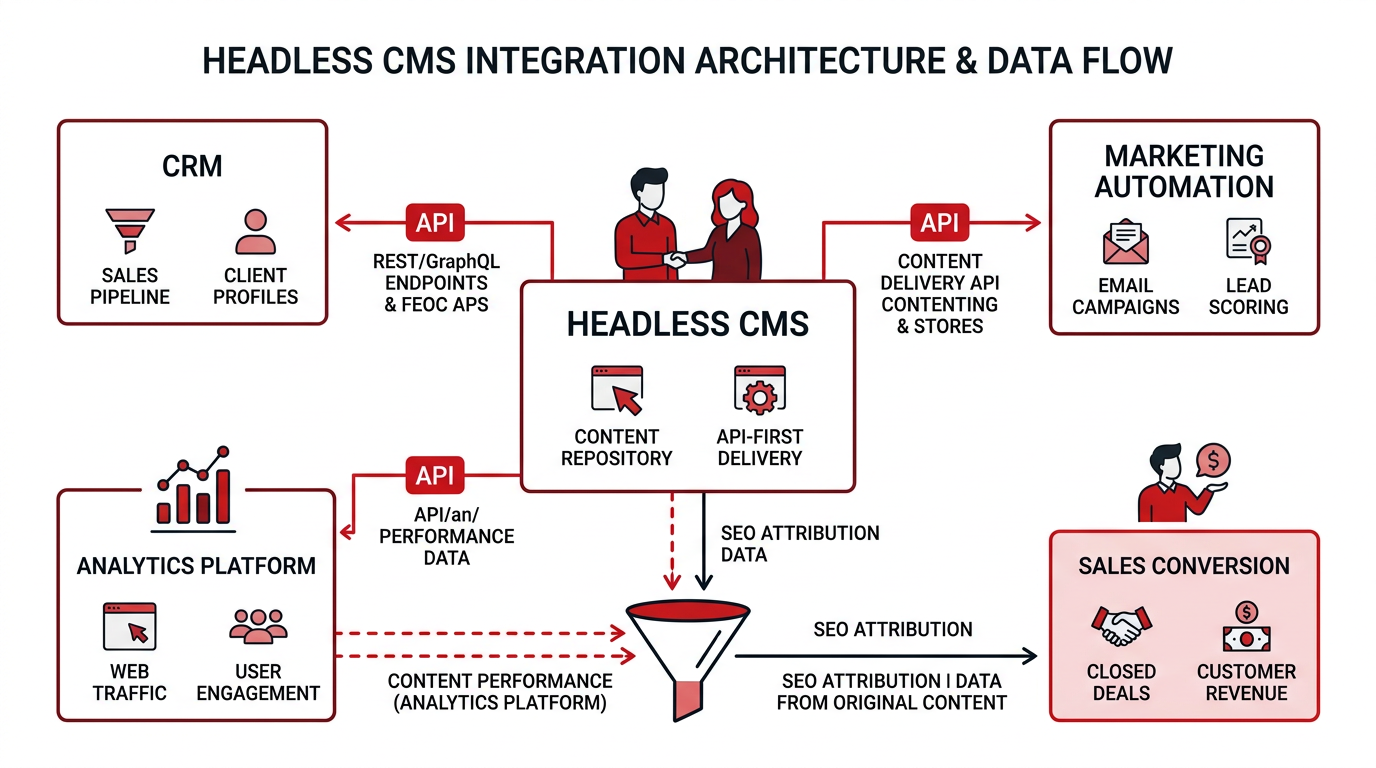
Connecting a headless CMS to HubSpot, Pardot, or an analytics stack via API does not automatically preserve SEO data flows attribution, structured data accuracy, and crawl behaviour all require deliberate configuration at integration design stage. For B2B MarTech teams, this is where lead attribution and organic performance reporting most commonly diverge.
Three integration points require explicit attention:
- CMS to HubSpot or Pardot: Organic lead attribution depends on UTM and source tracking passing correctly through the CMS-to-CRM API layer. If page URLs change or canonical tags shift during an integration update, attribution breaks silently. The choice between HubSpot and Pardot shapes how that integration is designed.
- Structured data accuracy across composable stacks: When CMS, personalisation layer, and analytics platform each affect page output, structured data fields can be overwritten or omitted without any single system flagging the error.
- Integration configuration: Floodlight configures CMS-to-CRM integrations with SEO data flows explicitly mapped, so organic attribution and structured data remain intact across stack changes.
Lead qualification speeds up when CRM and CMS integrations are configured so that organic attribution data reaches sales teams accurately and without manual intervention, a direct result of API-first CMS SEO configuration applied at the design stage rather than corrected after go-live.
Keeping AI search visibility
Visibility in AI-generated search results and answer engines is primarily determined by structured data accuracy and content model clarity both of which headless CMS builds can either support or undermine depending on how schema fields are configured and who controls them. For B2B MarTech teams, this is an emerging but already measurable risk.
Two points determine the outcome. First, structured data is the primary signal for AI search surfaces: AI answer engines and generative search features rely on structured data (JSON-LD, schema.org markup) to surface authoritative answers. In headless builds where structured data is hard-coded in front-end templates rather than driven from content model fields, schema accuracy depends on developer deployment cycles. When product data, pricing, or service descriptions change, schema lags and AI search visibility degrades accordingly.
Second, marketer-controlled schema fields outperform developer-managed templates in practice: when JSON-LD is generated from CMS content model fields, editors update structured data as naturally as they update body copy, keeping schema accurate without engineering involvement. This is the configuration pattern that produces consistent AI search visibility, and it is the same content modelling discipline covered in the earlier section on building SEO controls into a headless content model. Structured data governance in headless SEO best practice and editorial control are, in the end, the same problem.
Frequently Asked Questions
What is a headless CMS?
A headless CMS is a content management system that separates the content repository from the front-end presentation layer. MarTech teams manage content once and deliver it to any channel via APIs. Unlike traditional CMS platforms, there is no fixed template layer, giving developers and marketers independent control over content and display.
How does a headless CMS work for MarTech businesses?
A headless CMS stores content as structured data and serves it through APIs to whichever front-end or channel requests it. MarTech teams can feed the same content to websites, apps, and personalisation engines simultaneously. Editors work in a familiar interface while developers build performant front-ends without CMS constraints slowing them down.
What are the main benefits of a headless CMS for MarTech companies?
The main benefits include faster page performance, cleaner structured content for search indexing, and genuine omnichannel delivery without duplication. MarTech teams gain sharper control over technical SEO elements such as metadata, schema markup, and Core Web Vitals scores, which directly influence organic visibility and campaign landing page performance.
How long does a headless CMS take to implement?
Implementation typically takes between six weeks and six months, depending on content volume, integration complexity, and existing MarTech stack maturity. A straightforward site migration with a modern front-end framework sits at the shorter end. Enterprises migrating multiple content sources, CRM integrations, and localised content should plan for a phased programme.
Headless CMS vs traditional CMS what is the key difference?
A traditional CMS couples content management directly to a templated front-end, which limits performance tuning and channel flexibility. A headless CMS decouples them entirely, giving MarTech teams API-driven delivery and full front-end freedom. The practical trade-off is that headless requires stronger developer resource upfront but pays back through long-term SEO and scalability gains.
Is a headless CMS right for MarTech teams managing high-volume content operations?
Yes, if your team publishes across multiple channels, runs A/B testing on landing pages, or struggles with Core Web Vitals on a monolithic CMS. Headless suits MarTech operations where content velocity is high and SEO performance is a measurable priority. Smaller teams with simple single-site needs may find a traditional CMS more practical.
Final word: build SEO controls in before launch
Map meta fields, redirects and structured data into your headless content model before go-live, then run a full crawl within 48 hours of launch. Keeping SEO fields marketer-accessible is what protects organic performance long after the build is finished.
Book a discovery call