

AI Ethics Guidelines: A UK Tech Leader's Framework [2026]
An enterprise AI ethics policy sets clear rules for how technology teams build, deploy and monitor AI systems, covering fairness, transparency, data privacy, accountability and human oversight. For software and SaaS organisations, it reduces regulatory risk, prevents biased outputs and builds customer trust by defining who is responsible when automated decisions affect users.
UK technology firms must treat AI ethics policy as a procurement asset, not a compliance afterthought. Enterprise buyers now require documented governance evidence before contracts are signed.
- Procurement readiness: Documented AI governance frameworks shorten sales cycles and reduce deal risk by answering buyer due diligence questions before they are raised.
- Risk classification: Mapping AI use cases against EU AI Act risk tiers determines compliance obligations and prioritises governance controls for client-facing systems.
- Algorithmic transparency: Procurement and legal teams audit decision logic, not intentions. Maintaining model cards, input logs and plain-language explanations is non-negotiable.
- Human oversight: Configured review checkpoints and named accountability convert policy into practice, demonstrating that responsible automation and operational efficiency are complementary.
- Named accountability: A single AI ethics lead with defined review cadence and escalation authority outperforms committee ownership, delivering faster decisions and an auditable trail.
Introduction
UK technology firms face growing pressure to demonstrate responsible AI governance, and not just from regulators: enterprise procurement teams now routinely request documented evidence of AI ethics policy before contracts are signed. For mid-market businesses, getting this right is less about abstract principle and more about protecting the pipeline and reducing deal risk.
The conventional response has been to treat ethics documentation as a compliance task, something addressed after a regulatory trigger or a client complaint. That approach is no longer viable. The EU AI Act's risk-tier classifications create concrete obligations that require preparation, and UK enterprise buyers are applying their own procurement standards independently of any regulatory deadline. Firms that begin documenting governance controls only when asked are already signalling immaturity to the buyers who matter most.
Floodlight works with mid-market UK technology businesses to connect governance frameworks to operational practice, not just policy documents. That means building human-in-the-loop controls into live workflows, assigning named accountability, and ensuring that responsible automation delivers measurable outcomes. That combination matters commercially, because responsible automation and measurable efficiency are not in tension once oversight is designed into the workflow rather than bolted on afterwards. What follows is a structured framework covering risk classification, transparency obligations, and the governance evidence your next enterprise customer is likely to request.
What does an enterprise AI ethics policy actually need to cover for UK technology firms?
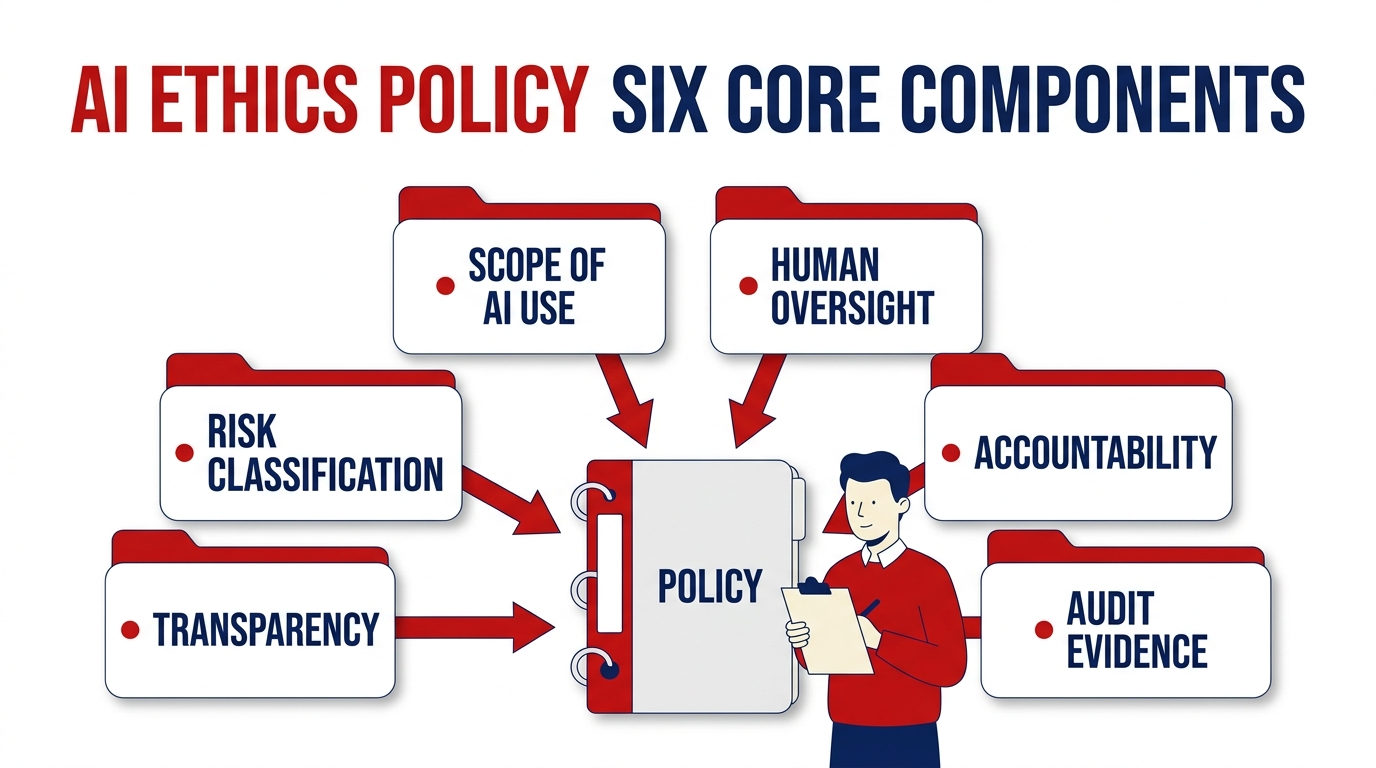
A UK technology firm's enterprise AI ethics policy must cover six core components: scope of AI use, risk classification, transparency commitments, human oversight, named accountability, and audit evidence. Together they constitute a procurement-readiness asset rather than a statement of intent, and enterprise buyers expect to see all six during vendor assessment.
In practice, procurement and legal teams audit specific artefacts: an AI use-case register, risk-tier mapping against the EU AI Act, decision-logic documentation for each production system, named accountability with defined review cadence, human-in-the-loop checkpoints, and data lineage records. The distinction between a policy document and an operational framework matters here; buyers want evidence that governance is embedded in live systems, not confined to a PDF. According to PwC's 2025 Responsible AI survey, 58% of executives say responsible-AI initiatives improve ROI and efficiency, which is why a governance framework you can evidence on request reads to a buyer as commercial maturity rather than paperwork. A responsible AI governance framework that can be evidenced on request is, at that point, a commercial differentiator.
|
40%
of enterprise applications will include task-specific AI agents by 2026, according to Gartner
|
How does the EU AI Act's risk-tier classification affect UK technology companies in 2026?
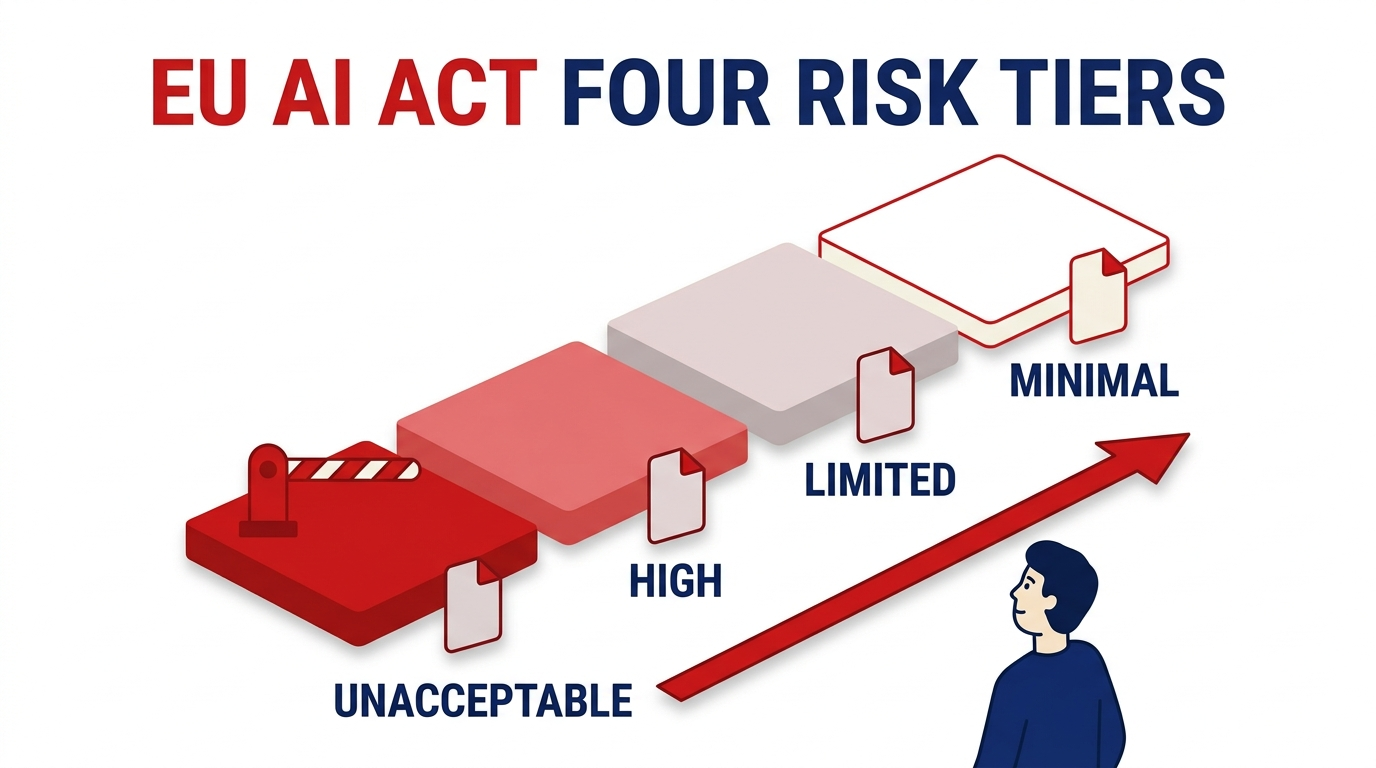
UK technology firms selling into or processing data from the EU are in scope for the EU AI Act regardless of post-Brexit status. The four risk tiers (unacceptable, high, limited and minimal) determine documentation and oversight obligations directly. Classification is the first decision any UK firm needs to make before building its compliance controls.
Recruitment, financial services, and public-sector decision-making are the UK deployment areas most consistently caught by the high-risk tier, because each produces an automated output that materially affects an individual. Common UK technology use cases map as follows: recruitment screening, credit decisioning, and biometric identification typically sit in the high-risk tier; chatbots and content generation typically sit in the limited-risk tier. Floodlight supports mid-market UK technology firms in mapping their AI automation use cases against these risk tiers during governance readiness reviews.
Which AI use cases are most likely to require immediate governance controls?
Client-facing systems, decision-automated workflows, and data-intensive processes are the priority. Any system that produces outputs affecting individuals' hiring decisions, credit assessments, or access controls warrants immediate classification and documented controls.
What compliance obligations attach to high-risk AI systems?
High-risk classification requires technical documentation, human oversight at defined checkpoints, post-market monitoring, and an auditable log of decisions. These are not optional additions; they are the minimum standard for EU AI Act compliance and increasingly for UK enterprise procurement due diligence.

How do you build algorithmic transparency into client-facing AI systems?
Algorithmic transparency means documented decision logic, traceable model inputs, plain-language output explanations, and a published methodology, not just stated intent. Procurement and legal teams audit artefacts, not aspirations: a transparency commitment unsupported by documentation will not pass vendor assessment.
Explainability and traceability now sit alongside security and uptime on enterprise vendor-assessment questionnaires, which means the artefacts have to exist before the questionnaire arrives. In practice, building transparency means maintaining a model card for each production system, logging input features and weightings, producing customer-facing explanation summaries, version-controlling prompts and decision rules, and creating an audit trail tied to a named owner.
Each artefact serves a dual purpose:
- It satisfies corporate AI ethics guidelines.
- It answers the specific questions enterprise legal teams raise during vendor assessment.
The work of building algorithmic transparency is, in effect, the work of building a defensible AI ethics framework for business.
What a human-in-the-loop control framework looks like in practice
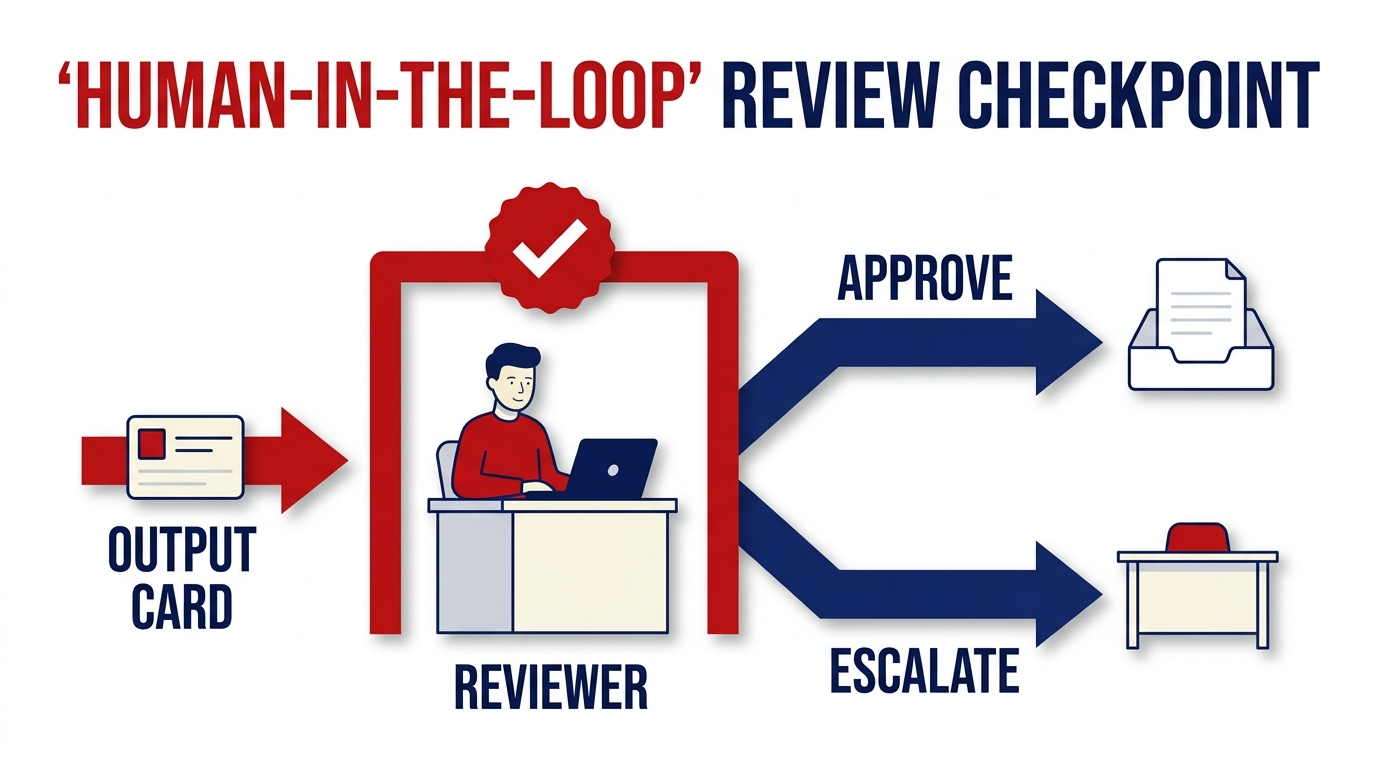
A human-in-the-loop control framework consists of configured review checkpoints inside automated workflows, defined escalation paths, named override authority, and documented trigger conditions that prevent fully autonomous decisions in high-risk scenarios. These are operational configurations, not policy statements.
In practice, checkpoints are set at confidence thresholds: outputs below a defined certainty level are routed to human review before action is taken. Edge cases follow a documented escalation path. All overrides are logged against a named reviewer, creating an audit trail for both internal governance and external due diligence. Review cadences are set in advance and owned by a named individual: weekly for high-volume systems, monthly for lower-frequency workflows. According to HubSpot's State of Marketing, about a third of marketers say AI saves their team 10 to 14 hours per week, and that time is not forfeited by adding review checkpoints; oversight and efficiency are complementary when the checkpoints sit inside the workflow. Floodlight's approach configures oversight inside live marketing automation workflows rather than adding governance as a separate layer.
How responsible automation improves efficiency?
Governance controls and operational performance reinforce each other when oversight is built into the workflow from the start. Confidence thresholds reduce error rates; named accountability reduces rework; audit logging reduces dispute resolution time. Each control produces a measurable outcome alongside its compliance function.
Who owns AI governance, and how to stop it stalling
A named AI ethics lead with a defined remit, review cadence, and escalation authority outperforms distributed committee ownership. Enterprise procurement and legal due diligence ask for a named individual, not a shared inbox. Diffuse accountability produces slow decisions and no audit trail.
The role requires a defined scope, a clear reporting line, decision authority for use-case sign-off, and a structured review cadence: quarterly policy review, monthly sign-off on new use cases, and an escalation path for high-risk classifications. Floodlight clients report faster lead qualification and reclaimed marketer time once governance validation and scored routing are configured, and a named owner with a defined review cadence is what keeps those controls current rather than historic. The same discipline that accelerates operational outcomes in enterprise AI governance also satisfies the accountability requirements that corporate AI ethics guidelines demand. Committee ownership stalls because no single person carries responsibility; a named lead converts policy into practice.
How an AI ethics framework speeds up procurement
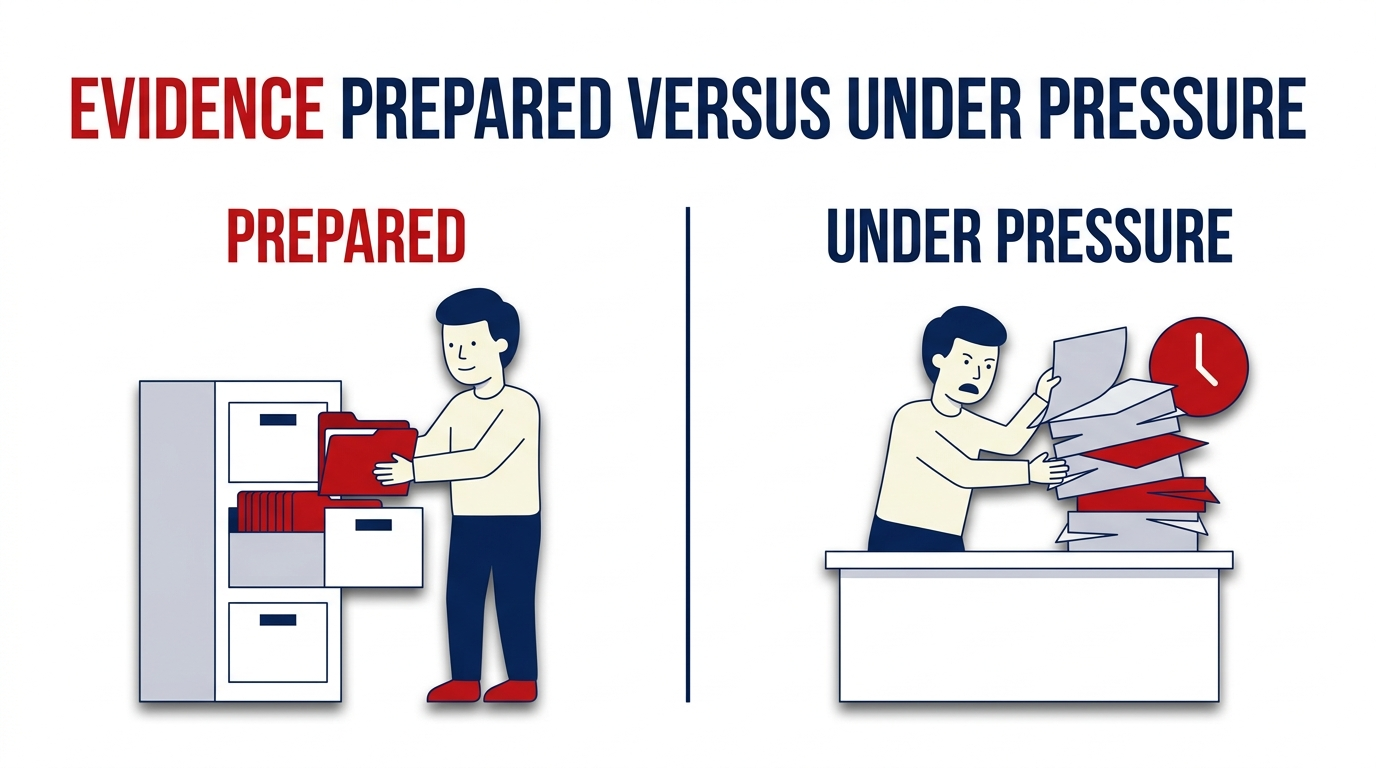
Prepared firms move through vendor assessment faster because they produce governance evidence on request, signalling maturity to enterprise buyers and reducing legal review cycles. The ethics policy, properly documented, functions as a revenue-enabling asset.
Enterprise procurement gates typically require: an AI use-case register, risk-tier classification, human oversight evidence, named accountability, and an audit trail. Firms that maintain these artefacts before they are requested compress vendor onboarding and reduce the volume of queries from enterprise legal teams. Each prepared document removes a bottleneck from the assessment process. B2B buyers spend just 17% of the entire buying journey meeting with potential suppliers, according to Gartner, so the governance evidence a procurement team reads without you in the room carries a disproportionate share of the decision. The connection between AI procurement due diligence readiness and pipeline performance is direct: the enterprise AI ethics policy that satisfies a legal team's checklist is the same asset that moves a deal from assessment to contract.
Treating AI ethics policy as a compliance document instead of a procurement asset
What happens: Firms delay documentation until a regulatory trigger or customer request, signalling immaturity during vendor assessment and extending legal review cycles that slow deal closure.
What to do instead: Maintain governance artefacts proactively: an AI use-case register, risk-tier mapping, decision-logic documentation, named accountability, and audit trails. Prepared evidence compresses procurement cycles and positions your ethics framework as a revenue-enabling asset.
Frequently Asked Questions
What is an enterprise AI ethics policy?
An enterprise AI ethics policy is a formal framework governing how a technology organisation develops, deploys, and monitors AI systems responsibly. It covers fairness, transparency, accountability, and data privacy. For UK tech businesses, it also ensures alignment with evolving domestic regulation and international standards such as the EU AI Act.
How does an enterprise AI ethics policy work for technology businesses?
An enterprise AI ethics policy works by embedding governance checkpoints throughout the AI development lifecycle. Tech teams assess models for bias, document decision logic, and assign clear accountability for outcomes. Regular audits and cross-functional review boards keep standards consistent as systems scale and regulatory requirements tighten across UK and global markets.
What are the main benefits of an enterprise AI ethics policy for technology companies?
An enterprise AI ethics policy reduces regulatory risk, strengthens client trust, and supports repeatable AI deployment across product lines. For technology companies, it also shortens procurement cycles, since enterprise buyers increasingly require documented ethical governance before signing contracts. Internally, it gives teams a clear decision-making framework when competing priorities arise.
How long does an enterprise AI ethics policy take to implement?
Implementing an enterprise AI ethics policy typically takes three to six months for a mid-size UK technology business. A basic policy with governance roles and audit processes can be operational in six to eight weeks. More comprehensive frameworks covering model risk, third-party AI use, and staff training naturally require longer planning and internal alignment.
Enterprise AI ethics policy vs AI compliance checklist: What is the key difference?
An AI compliance checklist confirms you have met minimum legal requirements at a point in time. An enterprise AI ethics policy is a living governance framework that guides ongoing decisions, assigns accountability, and adapts as technology and regulation evolve. The policy shapes culture; the checklist simply records whether specific boxes have been ticked.
Is an enterprise AI ethics policy right for early-stage UK technology companies?
Yes, if you are building AI-driven products or handling sensitive data, an enterprise AI ethics policy is worth establishing early. Waiting until you scale means retrofitting governance into existing systems, which is costly and disruptive. A proportionate initial framework, reviewed quarterly, keeps foundations sound without creating unnecessary overhead for a growing technology team.
Find out what your governance evidence is missing
Prepared governance artefacts compress vendor assessment cycles and reduce legal queries. Maintain your AI use-case register, risk-tier classification and named accountability now, because the next enterprise buyer will request them before issuing a contract. The AI Enhancement Audit maps your AI use cases against the risk tiers, checks the artefacts a procurement team will actually ask for, and tells you which ones you cannot yet produce. Fixed fee, £997, delivered as a written report you can hand to a buyer.
Book a discovery call