

B2B lead scoring helps Marketing Ops teams prioritise prospects by assigning values based on engagement and fit. Combining demographic and behavioural data lets you focus resources on high-intent leads, improve sales alignment, and increase conversion rates without overcomplicating your CRM workflows. Split scores into fit, engagement, and timing signals for maximum clarity.
Effective B2B lead scoring is not an algorithmic challenge. It is a configuration and governance decision that determines whether sales reps trust and act on the leads marketing sends them.
- Split your score: Separating fit, engagement, and timing into distinct components gives reps actionable context rather than a single opaque number that invites dismissal.
- Decay rules matter: Calibrating score decay to your observed deal velocity per segment keeps the model accurate and prevents stale leads from surfacing at the wrong moment.
- Behavioural intent signals: Pricing page visits, contract page views, and integration documentation downloads carry far greater predictive weight than raw page-hit volumes and should be scored accordingly.
- Shared MQL threshold: An SLA-backed handoff definition, authored jointly by marketing and sales, removes threshold disputes and makes slow follow-up on high-intent contacts a measurable issue.
- Quarterly retraining: Reviewing scoring weights against closed-won and closed-lost data each quarter replaces launch-day assumptions with revenue evidence and keeps the model commercially relevant.
Introduction
Marketing Ops teams invest heavily in building lead scoring models, yet the handoff to sales often stalls. The issue is not a lack of data or algorithmic sophistication. It is that a single opaque score of 85 out of 100 tells a sales rep nothing about why that lead matters or what to do next. Without that visibility, the score gets ignored and the model's potential is lost.
In 2026, buying cycles are longer, buying groups larger, and budget holders more cautious. A scoring system that collapses fit, engagement, and timing into one number cannot capture the nuance of a real buying situation. Reps need to see which leads are the right company, which are the right contacts, and which show current intent. Without that separation, the MQL-to-SQL handoff remains a point of friction rather than a pipeline driver.
The shift from a monolithic score to a transparent, multi-signal system is not a technical overhaul. It is a configuration and governance change. When scores are split and surfaced with context, sales teams trust them. Routing scored leads that meet fit and engagement thresholds directly to the right rep, with the score breakdown attached, gives sales a clear reason to act on them. The following sections give concrete techniques covering split scores, decay rules, behavioural triggers, and quarterly retraining so you can move from theory to measured improvement.
Why does a single lead score lose sales trust so quickly?
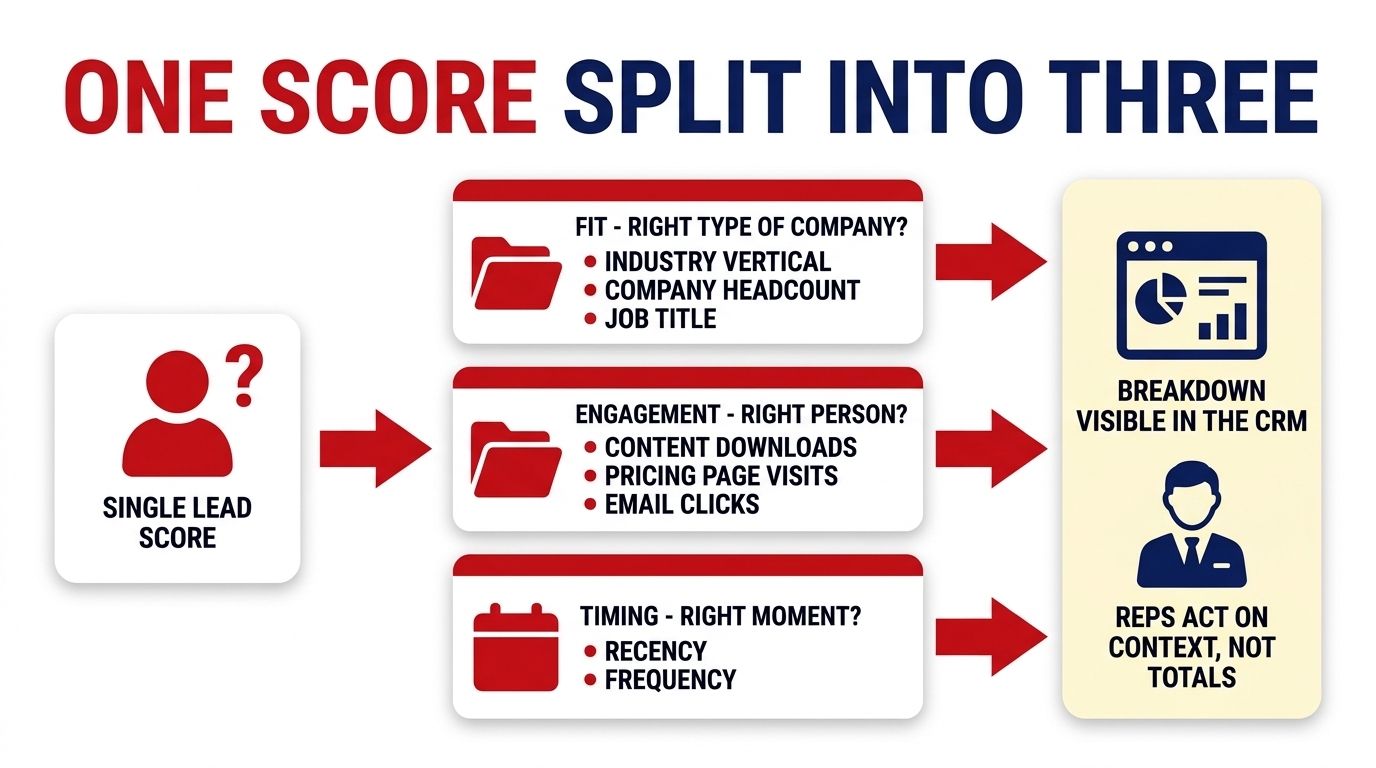
A single lead score fails because it collapses three distinct questions into one number: is this the right type of company, is this the right person, and is this the right moment? Without that breakdown, sales reps have no basis for action at the MQL-to-SQL handoff. A score of 85 tells a rep nothing useful on its own.
The structural problem is that a monolithic score gives no indication of which dimension drove it. A contact may have accumulated points almost entirely through email opens and blog visits, which is genuine engagement, but from someone at a company that falls outside any target vertical. When a rep discovers this after following up, the score loses credibility, and the next batch of MQLs gets deprioritised regardless of quality.
Splitting the score into fit, engagement, and timing components and surfacing the breakdown directly in the CRM addresses this more reliably than refining the underlying algorithm. Reps act on context, not totals. This is the configuration and change-management gap that most B2B lead scoring model guides skip entirely, and it is where most scoring programmes quietly fail. The question then becomes how that three-component structure is actually built inside a CRM.
What is B2B lead scoring and how does it function within a CRM?
Building on that framing, lead scoring is a method of assigning numerical values to contacts based on firmographic fit and behavioural engagement, so that sales effort is prioritised toward contacts most likely to convert. In CRM terms, it is a configuration task: properties are mapped to point values, and contacts accumulate scores as they interact or match criteria.
Inside HubSpot, for example, contact properties such as industry vertical, company headcount, and job title are each assigned point values on a fit dimension. Separately, behavioural interactions including content downloads, pricing page visits, and email clicks accumulate on an engagement dimension. A third dimension, timing, captures the recency and frequency of those interactions relative to a typical deal cycle.
Thresholds trigger workflow actions automatically: once a contact crosses a defined combined score, they are assigned to a rep, enrolled in a sequence, or flagged in a shared dashboard. In HubSpot, map fit, engagement and timing properties to distinct score components, so reps receive structured context at the point of lead qualification rather than a single aggregated total. How those three components are structured is where the configuration decisions get specific.
How should you split a lead score into fit, engagement, and timing signals?
Splitting a lead score into three separate components (fit, engagement, and timing) is a CRM configuration decision that gives sales reps visible, actionable context. A contact scoring 40 on fit, 30 on engagement, and 10 on timing tells a rep far more than a combined total of 80. It immediately signals whether to prioritise firmographic follow-up, re-engagement, or a time-sensitive outreach.
The three-signal architecture resolves the trust problem identified in the opening section by making the score's logic transparent. Reps can see why a contact is flagged, not just that it is.
How is fit scoring configured for firmographic and demographic criteria?
Fit scoring uses static or slowly changing CRM data: industry vertical, company headcount band, geography, and job title seniority. Point values are assigned to each property. A concrete HubSpot example: a contact at a company in the 50 to 250 employee band within a target vertical receives +20 points on the fit dimension; a contact outside that band receives zero or a negative adjustment. Fit scoring should be configured once and reviewed quarterly as ICP definitions evolve.
How does engagement scoring capture behavioural depth beyond page-visit volume?
Engagement scoring must distinguish high-intent interactions from low-intent activity. Pricing page visits, integration documentation downloads, webinar completions, and case study views carry disproportionate signal about genuine interest. Weighting these at three to five times the value of a generic blog visit or single email open surfaces that intent rather than rewarding volume. A contact who has read twelve blog posts but never visited a commercial page should not outscore one who visited pricing twice. That distinction is what separates a B2B lead scoring model from simple activity counting, and it shapes which contacts surface at the timing stage next.
How do you configure score decay rules that reflect real buying cycles?
Score decay rules automatically reduce engagement scores over time when a contact becomes inactive, preventing stale leads from surfacing at the wrong moment or active contacts from being pursued after interest has passed. Decay should be calibrated to observed deal velocity per segment, not set as a single universal timer across the entire database.
In practice, the configuration sets engagement scores to decrease by a fixed percentage during periods of inactivity. For example, 10% per week without a tracked interaction. Decay rates should differ by segment: enterprise deals with longer cycles warrant slower decay than transactional segments where buying decisions move quickly. A concrete example: a contact who visits the pricing page but takes no further action within 21 days has their engagement score halved automatically, reflecting a likely stall rather than active consideration.
These decay rules interact directly with the timing signal in the three-component model. As engagement decays, the timing score drops in parallel, giving reps an accurate picture of current purchase readiness rather than a historical engagement peak that no longer reflects the contact's behaviour.
Set decay parameters for each segment from its average deal velocity, so scoring reflects where a contact is in their buying process now, not where they were three months ago. That currency matters most when scoring high-intent behaviours, which carry their own distinct configuration logic.
What behavioural scoring triggers identify genuine purchase intent?
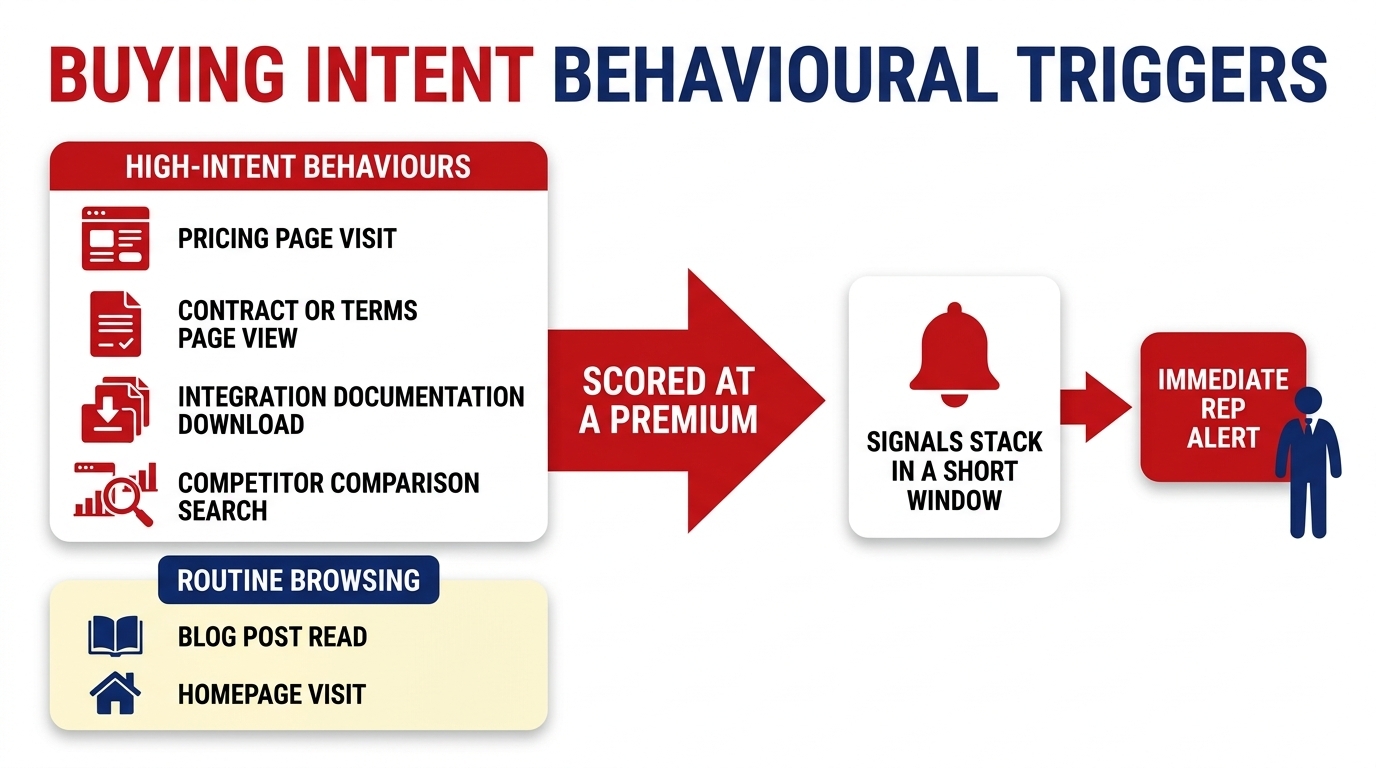
Genuine purchase intent is signalled by specific, high-value behaviours: pricing page visits, contract or terms-of-service page views, integration documentation downloads, and competitor comparison searches, rather than by the volume of general site activity. Scoring these triggers at a premium separates intent from routine browsing and protects rep time from low-probability follow-up.
Concrete trigger mapping makes this operational. A pricing page visit adds 15 points; an integration documentation download adds 20; viewing a contract or terms page adds 25. By contrast, a blog post read adds 2 points and a homepage visit adds 1. The differential is deliberate. It reflects the difference between a contact researching a category and one evaluating a specific purchase.
When multiple high-intent signals stack within a short window, for example three intent-level interactions within seven days, the configuration can trigger an immediate rep alert, separate from the standard MQL threshold workflow. This surfaces contacts who are moving quickly before they stall or speak to a competitor.
Configuring these trigger-based workflows requires clean URL tracking and event mapping in the CRM before scoring rules can be applied. A well-mapped trigger model only holds if the handoff threshold it feeds is equally well defined.
Building a scoring model once and never revisiting it
What happens: Prospect behaviour and product positioning change over time, so a model that is not reviewed quickly drifts from commercial reality. High-scoring leads stop converting, reps lose confidence in the queue, and the MQL-to-SQL conversion rate falls without a clear cause being identified.
What to do instead: Schedule a quarterly review to compare scoring history against closed-won and closed-lost deals, then recalibrate point weights to reflect the behaviours that actually preceded won deals in that period.
How do you define and enforce a visible MQL-to-SQL handoff threshold?
An MQL-to-SQL handoff threshold works when both marketing and sales have agreed on the pass criteria, expressed in plain terms such as "firmographic fit score above 30 plus a pricing page visit," and when that threshold is backed by a documented SLA specifying rep response time. Ambiguity at the handoff point is where scoring credibility collapses.
The practical steps are straightforward: write the MQL criteria in plain language using specific fit and engagement thresholds, agree on the rep response SLA (for example, contact within four business hours of handoff), and document both in a shared HubSpot dashboard visible to both teams. Deal stage timestamps in HubSpot make SLA adherence trackable without manual reporting.
An agreed, jointly authored definition reduces the "bad lead" argument because both teams contributed to setting the bar. When a rep rejects a lead, the rejection is measured against criteria they helped write, not criteria handed down by marketing. Slow response to high-intent contacts carries a measurable revenue cost; a documented SLA makes that cost visible rather than diffuse.
Write MQL handoff criteria as a joint marketing and sales definition, documented in HubSpot as a shared view, so threshold disputes are resolved at the process level rather than case by case. That shared definition also creates the data needed to run the next governance layer: negative scoring.
Where does negative scoring fit into a B2B lead scoring model?
Negative scoring deducts points when a contact shows disengagement signals, such as a job title change, prolonged inactivity, or an unsubscribe from all communications. These deductions protect sales time from pursuit of leads that have effectively gone cold. Without negative scoring, a B2B lead scoring model only accumulates; it never self-corrects.
The main triggers and their recommended deductions are practical to configure. A job title change detected via CRM enrichment removes fit points, because the contact may no longer hold buying authority. Inactivity beyond the segment decay threshold resets the engagement score. An unsubscribe from all email marks the contact as disqualified and removes them from active rep queues automatically.
In HubSpot, these deductions are configured using property-change workflows and enrichment tool integrations. When a monitored property changes, such as job title, company, or email status, the workflow fires and adjusts the relevant score component without manual intervention.
Negative scoring is frequently absent from initial model configurations and is one of the most cost-effective additions a Marketing Ops team can make. It removes dead-end contacts from active queues without requiring individual manual review, keeping rep attention on contacts that the scoring model confirms are still engaged. That confirmation becomes more reliable when the model is regularly retrained on actual outcomes.
How do you retrain a lead scoring model using closed-won and closed-lost data?
A lead scoring model should be reviewed quarterly by comparing the scoring history of closed-won and closed-lost deals, then adjusting point weights so that the behaviours and firmographic attributes that actually preceded won deals carry more weight. This replaces the assumptions built at model launch with revenue evidence.
The review process is a standard CRM reporting task. Pull all deals closed in the quarter, segmented by outcome. Compare fit, engagement, and timing scores at the point of MQL handoff for each group. Identify which score components were consistently higher in closed-won deals. Adjust weights in the CRM configuration to reflect what the data shows, not what the original model assumed.
Teams running this review regularly find that one or two behavioural signals carry disproportionate predictive weight. Integration documentation downloads and pricing page revisits are common examples and should be promoted in the model. The quarterly review is also the moment to assess whether new content assets or touchpoints should be added to the scoring framework. Teams running a connected marketing operations programme will typically find new touchpoints to score each quarter as content coverage expands.
Review scoring every quarter by mapping HubSpot deal data against scoring history, and adjust weights to reflect the behaviours that preceded closed-won deals rather than assumptions set at model launch. To judge whether each review is helping, track conversion by score band using the metrics in our guide to lead scoring analytics and conversion metrics for Marketing Ops. That cadence matters as much as the configuration, which brings scoring governance back to a question of team alignment.
How do you align sales and marketing teams around a shared scoring definition?
Scoring model credibility depends on governance as much as configuration. Specifically, it depends on joint threshold reviews, shared dashboards, and agreed SLAs that keep both teams accountable to the same definition of a qualified lead over time, not just at initial setup. A model configured once and left untouched will drift from commercial reality within two quarters.
The governance steps that sustain alignment are operational rather than technical. A quarterly joint review meeting gives sales and marketing a shared moment to examine MQL-to-SQL conversion rates, score distributions, and handoff volumes together. A shared HubSpot dashboard makes SLA adherence visible to both sides without requiring a separate report request. An agreed escalation path for leads that were passed but rejected by sales replaces informal complaint with a structured feedback loop.
The quarterly cadence is what keeps the model credible. When reps can see that their rejected-lead feedback visibly changed point weights in the following quarter's configuration update, the model becomes a shared tool rather than a marketing artefact. Sales trust in lead scoring increases not through persuasion, but through demonstrated responsiveness. When the model reflects what reps have told the team works, the MQL-to-SQL handoff becomes a process both sides are willing to defend.
Conclusion
Sales trust in lead scoring is built through a model that is transparent, governed jointly, and updated against real deal outcomes. For Marketing Ops teams, the shift from a single aggregated score to a structured fit, engagement, and timing breakdown changes what happens at the MQL-to-SQL handoff: reps receive context they can act on, and rejected leads produce structured feedback rather than quiet deprioritisation. A scoring model does not need to be complex to help sales. It needs to be legible to the people acting on it.
If your current model has drifted from commercial reality, or you have never had a joint threshold definition in place, the next step is to scope what a configurable three-component model would look like in your CRM. Get in touch to scope your CRM configuration.
Frequently Asked Questions
What is lead scoring?
Lead scoring is a method of ranking prospects by assigning numerical values to their behaviours and attributes, indicating how likely they are to buy. For Marketing Ops teams, it creates a shared, objective framework that aligns marketing and sales around which leads deserve immediate attention and which need further nurturing.
How does lead scoring work for Marketing Ops businesses?
Lead scoring works by combining demographic data (job title, company size, industry) with behavioural signals such as email opens, page visits, and content downloads. Marketing Ops teams configure scoring rules inside their CRM or automation platform, setting thresholds that trigger handoffs to sales when a prospect reaches a defined score.
What are the main benefits of lead scoring for Marketing Ops companies?
Lead scoring reduces wasted sales effort by ensuring reps only contact genuinely qualified prospects. For Marketing Ops teams, it also improves reporting accuracy, shortens sales cycles, and gives clearer evidence of marketing's pipeline contribution, making it easier to justify budget and demonstrate measurable return on marketing investment.
How long does lead scoring take to implement?
A basic lead scoring model typically takes two to four weeks to configure and test. A more sophisticated predictive model, incorporating CRM data and behavioural history, can take six to twelve weeks. The timeline depends largely on data quality, the complexity of your scoring criteria, and how well marketing and sales agree on definitions.
Lead scoring vs lead qualification: what is the key difference?
Lead qualification is a manual, conversation-based judgement made by a sales rep, often using frameworks like BANT. Lead scoring is a systematic, automated process applied at scale before sales engagement. Scoring identifies who to contact; qualification confirms whether that contact is genuinely ready to buy after a direct conversation.
Is lead scoring right for Marketing Ops teams managing multiple product lines?
Lead scoring is particularly well suited to Marketing Ops teams running multiple product lines, because separate scoring models can be built for each audience. This prevents mismatched lead routing, where a prospect interested in one solution is mistakenly sent to the wrong sales team, which is a common source of pipeline leakage.
What is the most common mistake Marketing Ops companies make with lead scoring?
The most common mistake is building a scoring model once and never revisiting it. Prospect behaviour and product positioning change, so scores quickly become inaccurate. Marketing Ops teams should schedule a quarterly review to check whether high-scoring leads are actually converting, and recalibrate thresholds accordingly to keep the model commercially relevant.
What metric should I track to measure lead scoring success?
Track Marketing Qualified Lead to Sales Qualified Lead conversion rate, broken down by score band. In a well-calibrated model the top band converts clearly better than the middle. If it does not, your scoring thresholds are too loose and need tightening to reflect the behaviours that predict genuine purchase intent. For how to read these numbers in full, see our guide to lead scoring analytics and conversion metrics for Marketing Ops.
Final word: transparent scoring builds the sales trust that algorithms cannot
A three-component scoring model, reviewed quarterly against closed-won data and governed with a joint MQL threshold, produces faster lead qualification and fewer wasted handoffs. Configure for clarity first, then refine the weights as deal evidence accumulates.
Book a discovery call