
Answer engine optimisation (AEO) is the practice of structuring content so AI assistants and search engines can extract and deliver it as direct answers, reshaping how marketing operations teams measure performance and plan content. For marketing ops, AEO shifts focus from clicks and rankings to zero-click visibility, requiring structured data, clear question-based content, and continuous optimisation to capture AI-driven demand.
Answer engine optimisation shifts focus from traditional search rankings to AI-driven visibility. For marketing ops teams, success depends on infrastructure, cross-team coordination, and measurement frameworks, not content quality alone.

- Infrastructure over copy: AI citations depend primarily on crawler access, schema markup, and external domain coverage rather than writing quality in isolation.
- Cross-team workflows: PR, content, and technical teams must align around a shared topic map to build consistent citation signals across on-site and off-site sources.
- New measurement framework: Track AI citation rate and share of AI voice as distinct KPIs, separate from organic search ranking, to measure zero-click visibility.
- Content freshness cadence: Cited pages go stale, and a structured quarterly review is what keeps them current rather than an ad hoc rewrite after a performance drop.
- Pipeline connection: Link citation signals to CRM and lead data to measure AEO's contribution to qualified pipeline, not just visibility metrics.
Introduction
Answer engine optimisation has moved from a search novelty to a live operational concern for marketing ops teams in UK B2B. As buyers increasingly consult ChatGPT, Perplexity and Google's AI Overviews before they reach a website, the search behaviours that once fed the top of the funnel are shifting. Marketing ops teams are left managing dashboards built around organic rankings that no longer reflect how prospects actually find and evaluate suppliers.
The conventional response misses the point. Most AEO coverage frames this as a content writing problem, revise the pages, add schema, hope for citations. In practice, AI citations depend on infrastructure and cross-team coordination. With an estimated 31.3% of the US population expected to use generative AI search in 2026 (EMARKETER), the top-of-funnel visibility at stake is substantial, so PR, content and technical teams need to align around citation triggers. The shelf life is short too, so a citation earned this quarter is not a citation held next quarter.
Floodlight treats answer engine optimisation as an operational challenge first. By integrating CRM data with marketing automation through HubSpot, Pardot, n8n and Make, we help marketing ops teams connect citation signals to lead and pipeline outcomes, turning AEO from an act of content faith into a measurable strategy. The sections below set out the workflows, measurement frameworks and technical adjustments needed to build one.
What is answer engine optimisation?
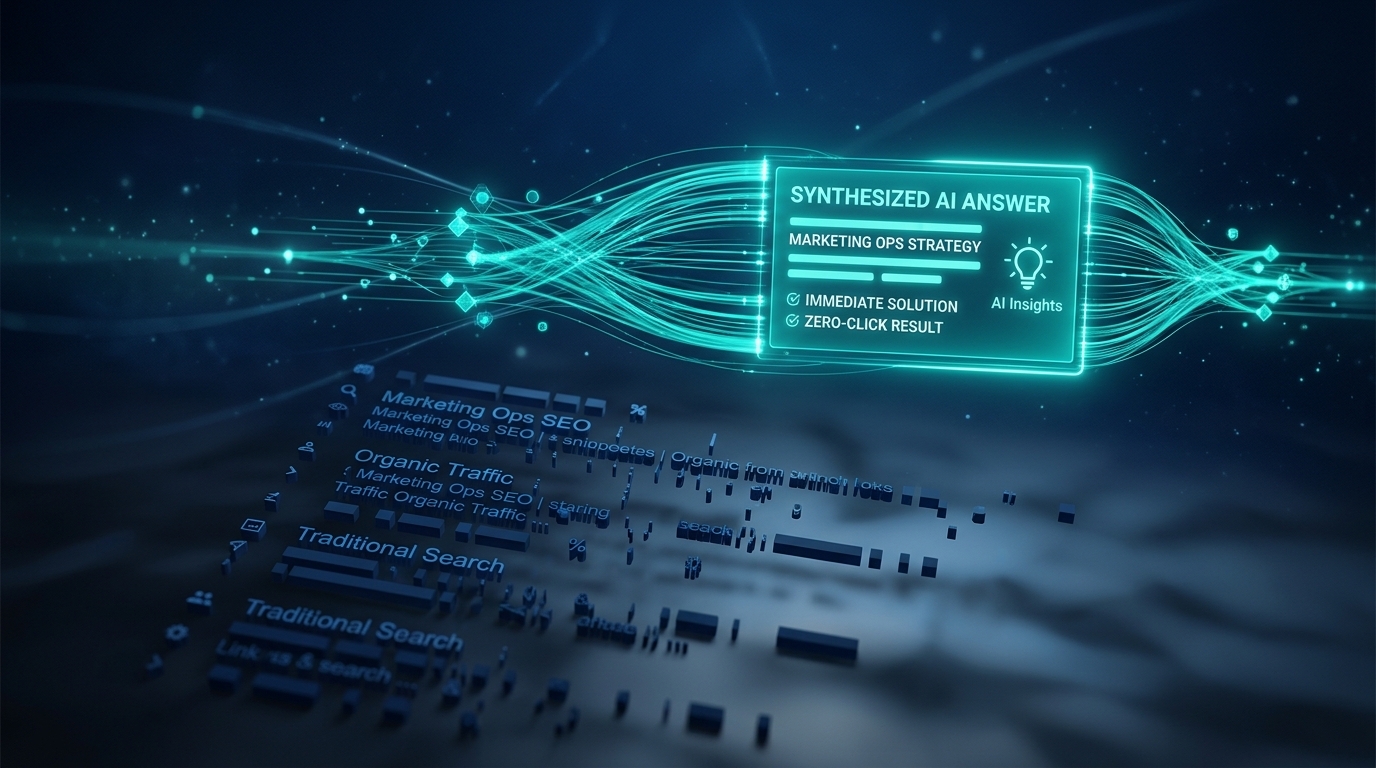
Answer engine optimisation is the practice of configuring content and infrastructure so that AI-driven answer engines (ChatGPT, Perplexity, Google AI Overviews) retrieve and cite your organisation accurately in response to buyer queries. For UK B2B marketing teams, this is fundamentally an infrastructure and workflow problem, not a writing task.
Unlike traditional SEO, which focuses on ranking a page within a results list, answer engine optimisation requires that your content is technically accessible to AI crawlers, marked up with structured data, and supported by external domain coverage that signals subject authority to LLMs. It differs from generative engine optimisation (a term often used interchangeably) in that it focuses specifically on retrieval accuracy rather than the quality of generated output. Both concepts converge at the same operational challenge: the signals that determine whether an organisation is cited are built through content infrastructure, technical configuration, and cross-team workflow coordination, which places ownership squarely in marketing ops. Gartner predicts traditional search-engine volume will fall 25% by 2026 as AI chatbots and answer engines absorb queries (Gartner). That is top-of-funnel B2B traffic that previously arrived through inbound channels, and the ops layer is now responsible for where it goes instead.
|
25%
forecast drop in traditional search volume by 2026 (Gartner)
|
~60%
of Google searches end without a click, 58.5% in the US (SparkToro, 2024)
|
16%
of all searches now return a Google AI Overview (EMARKETER)
|
How AI search is changing B2B buying
Building on that shift in search volume, B2B buyers are increasingly using AI tools (ChatGPT, Perplexity, Google AI Overviews) to shortlist suppliers before a sales conversation begins. Pipeline visibility is now won or lost during AI-answered research phases that may never produce a click to your website. This changes the commercial weight of AI citation significantly.
The practical shift is straightforward: a buyer asks an AI tool "which CRM integration agencies in the UK work with manufacturing clients?" and receives a synthesised response, often without visiting any of the cited organisations' websites. Nearly 60% of Google searches now end without a click (58.5% in the US), according to SparkToro's 2024 zero-click study. For B2B organisations whose inbound marketing strategy depends on page visits generating form fills, this zero-click dynamic significantly compresses the window in which they can be discovered. Buyers conducting AI-assisted research form supplier shortlists before reaching a company's own content, meaning that an absence from AI-generated answers represents a genuine top-of-funnel visibility gap, not merely a ranking drop. The question that follows is whether that absence is a content problem or an infrastructure one.
Why citations depend on infrastructure, not content
In practice, AI citation is determined primarily by infrastructure signals, crawler access, schema configuration, external domain authority, and content freshness, not by writing quality in isolation. A well-written page that blocks AI crawlers or lacks structured markup will not be cited regardless of how clearly it is written.
Google AI Overviews now appear in at least 16% of all searches, according to EMARKETER, which means a substantial proportion of top-of-funnel B2B queries are already receiving AI-synthesised responses. That scale reframes answer engine optimisation as a cross-functional coordination problem: E-E-A-T signals, third-party brand mentions, AI crawler access, and retrieval-augmented generation principles all contribute signals that no single team controls. Content, PR, and technical functions each influence the citation profile, and without a coordinating layer, each team optimises in isolation. That coordination role belongs to marketing ops, which points directly to the workflows required.
The cross-team workflows that build citations
Building citation signals requires a documented workflow connecting three functions: PR, content, and technical. PR earns external domain mentions; content creates answer-first topic authority; technical ensures crawler access and structured data are correctly configured. Marketing ops is the coordinating layer, without it, these functions optimise in isolation and citation signals remain fragmented.
Coordinating PR and content on citations
The alignment mechanism is a shared topic map, not separate editorial calendars. Content teams publish topic-authority pages on the subjects where the organisation wants AI citation; PR teams pitch commentary and by-lined articles on those same subjects to relevant trade publications and external domains. When LLMs retrieve information on a given topic, they encounter both on-site and off-site coverage attributing subject expertise to the same organisation. That reinforcement is what builds citation confidence, a single well-optimised page without corresponding external coverage will carry less retrieval weight than one supported by consistent third-party mentions.
The technical team's role
Technical teams carry three specific responsibilities: confirming that AI crawlers are not blocked in robots.txt or equivalent configuration files, implementing structured data markup (FAQ, HowTo, and Article schema) that helps LLMs parse content accurately, and ensuring that content architecture places the direct answer before supporting detail in each section. That last point reflects how LLMs extract citations: they pull the opening chunk of a section, so burying the key claim in paragraph three means it is frequently overlooked.
Gartner predicts 40% of enterprise applications will include task-specific AI agents by 2026, up from less than 5% in 2025, which means the AI-driven environment in which these citation signals must operate is expanding rapidly. Floodlight's experience integrating CRM and automation into existing stacks reflects the same coordination challenge: aligning content, PR, and technical functions around citation signals mirrors the work of connecting disparate systems so they produce coherent, measurable outputs rather than siloed activity.
Structuring content so AI can extract it
Content structured for AI retrieval places the direct answer in the first one to two sentences of each section, uses schema markup to label content type, and avoids burying key claims in long paragraphs. These are configuration decisions, not stylistic preferences, and responsibility for them sits with marketing ops and technical teams rather than writers alone.
The practical steps follow a clear pattern: answer-first structure leads each section with its direct response, with supporting detail following; FAQ and Article schema markup helps LLMs parse intent and extract content accurately; and retrieval-augmented generation principles (AI systems pull defined content chunks rather than reading prose continuously) mean that well-delineated sections consistently outperform dense paragraphs for AI citation rate. The underlying data quality principle applies throughout: inconsistent or contradictory claims across related pages reduce citation confidence for LLMs, which will either skip the content or misrepresent it. According to Gartner, poor data quality costs organisations at least $12.9 million per year, the same discipline that governs clean CRM data and accurate automation triggers applies directly to content configuration. Floodlight applies this principle consistently: the rigour used to configure a HubSpot CRM integration (ensuring clean data flows and consistent field values) is the same rigour required to maintain content extractability.
See where your brand stands in AI search
We will look at where you are cited today, which competitors AI tools recommend in your place, and where the strongest opportunities sit in your existing content and infrastructure.
Book a discovery callMeasuring AI visibility and share of voice
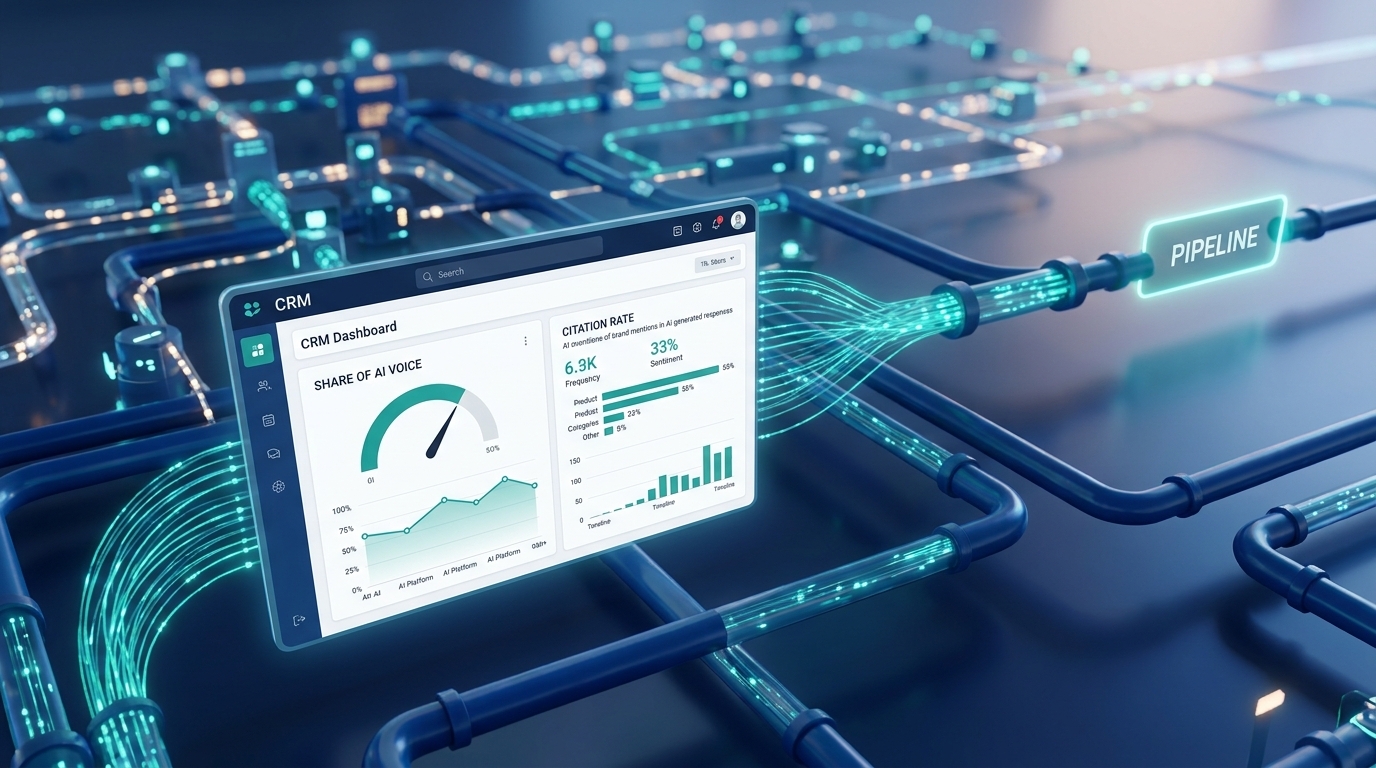
AI visibility measurement requires two distinct KPIs that most marketing ops dashboards do not yet include: AI citation rate, which measures how often your content is cited in AI-generated answers for target queries, and share of AI voice, which measures your proportion of citations relative to competitors. Both are separate from organic rank and require separate tracking infrastructure.
Which tools track AI citations today
The practical options divide clearly by team size and budget. Profound is a dedicated AI citation monitoring platform suited to teams with sufficient query volume and tooling budget, it tracks citation appearances across multiple AI environments and surfaces share of AI voice data systematically. Perplexity's own analytics offer citation visibility, but only within that platform's environment, making them insufficient as a standalone measurement approach. Manual auditing, defining a query set, running those queries regularly across ChatGPT, Perplexity, and Google AI Overviews, and logging results in a spreadsheet, is a viable starting point for UK mid-market teams that are not yet ready to invest in dedicated tooling.
A structured query set and consistent logging cadence are what matter most at the outset. According to HubSpot's State of Marketing, about a third of marketers say AI saves their team 10–14 hours per week, which illustrates why automating citation monitoring, rather than performing it manually at scale, becomes necessary as query volumes grow. Share of AI voice should be reviewed alongside organic rank rather than replacing it, since each metric describes a different stage of the buyer's research process.
Treating AEO as an SEO add-on
What happens: Marketing ops teams optimise page titles and meta descriptions but ignore answer-ready formatting, no FAQ blocks, no concise definitions, no schema markup. AI engines simply extract a competitor's cleaner content instead, and the organisation loses visibility in zero-click results.
What to do instead: Build AEO as a separate workstream with its own content configuration standards, schema implementation checklist, and quarterly refresh cadence. Treat citation presence as a distinct KPI alongside organic rank, not a by-product of existing SEO activity.
Connecting AEO metrics to pipeline
AI citation signals become useful to the business only when they are connected to lead and pipeline data. Marketing ops teams using HubSpot, Pardot, n8n, or Make can route citation-driven traffic and engagement signals into CRM workflows to measure answer engine optimisation's contribution to qualified pipeline, rather than treating AI visibility as a standalone vanity metric.
The integration works through existing attribution infrastructure. AI citation monitoring generates a query list and citation log; when a cited page receives a visit that converts to a form fill or CRM contact, that attribution path is configured using UTM parameters, page-level lead source tracking, or automation triggers in marketing automation platforms such as n8n or Make. The result is a pipeline attribution view that includes AI-referred traffic alongside organic, paid, and direct channels. Floodlight clients report faster lead qualification and reclaimed marketer time once governance validation and scored routing are configured into their existing stack, the same principle applies to AEO-sourced contacts entering a scoring workflow. Citation signals stop functioning as awareness indicators and start contributing to pipeline visibility when the routing and scoring logic is correctly configured. That closed loop between AI visibility and pipeline measurement depends on one further operational discipline: keeping cited content current.
How often content needs refreshing
Maintaining AI citation presence requires a documented refresh cadence built into the marketing ops content calendar, not ad hoc updates triggered by performance drops. This is a systems and scheduling problem, not a writing one.
The practical cadence starts with identifying the highest-value pages: those already earning AI citations or explicitly targeted to earn them. Quarterly reviews are the minimum viable frequency. A meaningful refresh involves more than rewording, it includes updating statistics, revising answer-first openings to reflect current framing, revalidating schema markup, and confirming that external citation coverage still aligns with the page topic. The data quality principle applies here too: a refresh that introduces inconsistencies between related pages, contradictory claims, mismatched schema values, or outdated figures that conflict with newer pages, reduces citation confidence for LLMs across the whole topic cluster, not just the updated page. Documenting what constitutes a valid refresh, who is responsible for each element, and how often the highest-priority pages are reviewed transforms content freshness from an editorial aspiration into an operational standard that marketing ops can govern, audit, and enforce.
Conclusion
Answer engine optimisation is, at its core, a marketing ops infrastructure problem: crawler access, schema configuration, cross-team workflow coordination, and content freshness cadence determine citation presence far more than writing quality alone. For UK B2B teams whose top-of-funnel visibility previously depended on organic page visits, the practical consequence is direct, buyers are forming supplier shortlists inside AI tools before they reach your website, and whether your organisation appears in those answers is governed by systems, not copy.
The teams that address this methodically, connecting PR coverage, technical configuration, CRM attribution, and refresh governance into a single coordinated workflow, will hold pipeline visibility that others lose quietly. If you want to understand where your current stack leaves gaps, book a discovery call.
Frequently Asked Questions
What is answer engine optimisation for marketing operations teams?
Answer engine optimisation is the practice of structuring content and technical infrastructure so AI answer engines such as ChatGPT, Perplexity and Google AI Overviews retrieve and cite your organisation accurately. For marketing operations teams, it shifts the focus from page rankings to whether your brand appears inside AI-generated answers during buyer research.
How does answer engine optimisation actually work?
Answer engine optimisation works by making content extractable and trustworthy to AI systems. Crawlers must be able to access your pages, structured data labels the content type, and the direct answer sits at the start of each section. External coverage across trade sites and directories then reinforces the signals that decide citation.
What are the benefits of answer engine optimisation for a B2B marketing ops team?
The main benefit of answer engine optimisation is visibility during zero-click research, where buyers form shortlists inside AI tools before visiting any website. Marketing ops teams also gain a clearer measurement framework, tighter coordination between PR, content and technical functions, and a route to connect AI citations back to pipeline rather than vanity metrics.
How much time and cost does answer engine optimisation require?
Cost depends on tooling and team maturity. Manual citation auditing in a spreadsheet costs only staff time and suits smaller teams, while dedicated monitoring platforms carry a subscription. Expect answer engine optimisation to demand ongoing effort, including a quarterly content refresh cadence, rather than a single one-off project.
How is answer engine optimisation different from traditional SEO?
Traditional SEO aims to rank a page within a list of results so users click through. Answer engine optimisation aims to be cited inside a synthesised AI answer, often with no click at all. It relies more on structured data, external domain authority and answer-first formatting than on keyword position alone.
Which teams and businesses does answer engine optimisation suit?
Answer engine optimisation suits B2B organisations whose buyers research suppliers through AI tools before making contact, particularly those whose inbound pipeline once depended on organic page visits. It fits marketing operations teams willing to coordinate PR, content and technical work, since citation signals are built across functions rather than by one team.
What is the most common answer engine optimisation mistake?
The most common answer engine optimisation mistake is treating it as an SEO add-on rather than a distinct discipline. Teams polish titles and meta descriptions but skip answer-ready formatting, concise definitions and schema markup. AI engines then extract a competitor's cleaner content instead, and the organisation quietly loses visibility in zero-click results.
What is the one metric to track for answer engine optimisation?
Track AI citation rate: how often your content is cited in AI-generated answers for your target queries. It measures whether your organisation appears where buyers now research, sits separately from organic rank, and gives marketing operations teams a direct signal of answer engine optimisation progress over time.
Final word: systems govern citations, not copy
Build a documented AEO workflow that connects PR coverage, technical configuration, CRM attribution, and quarterly refresh governance. Pilot it on your highest-value pages for 90 days and measure AI citation rate before extending the approach across the full content library.
Book a discovery call